





Why Incubator Temperature Differs From Egg Shell Temperature
By Dr. Marleen Boerjan, Embryologist, Pas Reform - The most critical factor in commercial incubation is the temperature that the developing embryo experiences. 10 July 2006
 1 minute read
Why Incubator Temperature Differs From Egg Shell Temperature - By Dr. Marleen Boerjan, Embryologist, Pas Reform - The most critical factor in commercial incubation is the temperature that the developing embryo experiences.

Typically, differentiation of organs occurs in the first days of
incubation. The growth and the maturation of the organs
occur in the later phases of development. Each of these
phases requires specific incubator conditions.
As the embryo grows, its metabolic rate increases and this is
accompanied by increased heat production. Consequently,
the natural pattern of the embryo and eggshell temperature
shows an increase towards the end of incubation.
In the incubator we must differentiate between the
temperature set point at which the incubator operates and
the temperature of the air at the level of the eggs, which
determines the temperature of the egg and embryo.
At the start of incubation the embryo produces little heat and eggs must be warmed. This means that the air temperature must be higher than the egg temperature. As the embryo grows, metabolic heat production increases and to prevent overheating the air surrounding the eggs must be cooled such that heat is removed from the eggs. In figure 1, a typical incubation program for a broiler embryo is summarized.
Figure 1. Summary of the relationship between average egg shell temperature (dotted lines: n=30 eggs) and the incubator set point (lines) in a commercial incubator. The red line represents an incubator temperature program resulting in an average egg shell temperature between days 5 and 10, which was lower than the desired egg shell temperature of 100 ºF. The average eggs shell temperature increased to the desired level when set point was adjusted by 0.2 ºF (green line).
Background
Embryonic development is a continuous process that can
roughly be divided into three different phases:
(1) differentiation; (2) growth and (3) the maturation.
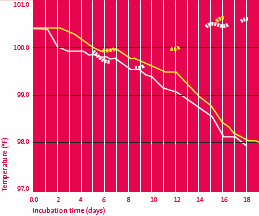 Figure 1. Relationship between average egg shell temperature (dotted lines: n=30 eggs) and the incubator set point (lines) in a commercial incubator. |
At the start of incubation the embryo produces little heat and eggs must be warmed. This means that the air temperature must be higher than the egg temperature. As the embryo grows, metabolic heat production increases and to prevent overheating the air surrounding the eggs must be cooled such that heat is removed from the eggs. In figure 1, a typical incubation program for a broiler embryo is summarized.
Figure 1. Summary of the relationship between average egg shell temperature (dotted lines: n=30 eggs) and the incubator set point (lines) in a commercial incubator. The red line represents an incubator temperature program resulting in an average egg shell temperature between days 5 and 10, which was lower than the desired egg shell temperature of 100 ºF. The average eggs shell temperature increased to the desired level when set point was adjusted by 0.2 ºF (green line).
Advice
For optimum development in the incubator, the eggshell
temperature should be within a range of 37.6-37.9 ºC (99.7-
100.2 ºF) during the first two-thirds of incubation and 38.1-
38.8 ºC (100.6-101.8 ºF) during the last days in the setter.
Source: Pas Reform - June 2006