





Feds to Toughen Meat, Poultry Inspection
WASHINGTON - The first major changes to food inspection in a decade will increase federal scrutiny of meat and poultry plants where the danger from E. coli and other germs is high or where past visits have found unsafe practices. 20 February 2007
 2 minute read
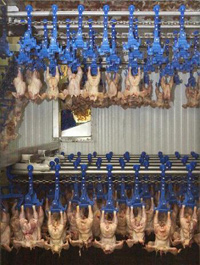 Chickens hang from steel rails as they are air chilled at the MBA Poultry plant in Tecumseh, Neb., in this May 8, 2003 file photo. The first major changes to food inspection in a decade will increase federal scrutiny of meat and poultry plants where the danger from E. coli and other germs is high or where past visits have found unsafe practices. The new policy will result in fewer inspections at plants with lower risks and better records for handling meat and poultry. Chickens hang from steel rails as they are air chilled at the MBA Poultry plant in Tecumseh, Neb., in this May 8, 2003 file photo. The first major changes to food inspection in a decade will increase federal scrutiny of meat and poultry plants where the danger from E. coli and other germs is high or where past visits have found unsafe practices. The new policy will result in fewer inspections at plants with lower risks and better records for handling meat and poultry. |
The new policy will result in fewer inspections at plants with lower risks and better records for handling meat and poultry.
"We're just putting resources where the risk is greatest, and those plants that demonstrate excellent control will get less of our resources," said Richard Raymond, the Agriculture Department's top food safety official.
To decide the level of scrutiny a plant should get, the "risk-based" system will consider the type of product and the plant's record of food safety violations.
A plant that makes hamburger and has repeated violations would get more inspection. A plant that makes cooked, canned ham and has a clean track record would get less scrutiny.
"There are certain food products that carry a higher inherent risk than others," Raymond, the undersecretary for food safety, said in an interview with The Associated Press. "And there are certain plants that do a better job of controlling risk than others.
For now, the new system will be used in processing plants, not in slaughter plants. No timetable has been set for shifting to the new inspection system, although the Agriculture Department is expected to release one within the next few weeks.
Critics say the idea sounds good, but they fear department officials are rushing a complex new system into place.
"One of the concerns is that this is simply an effort to save money in a tight budget year," said Caroline Smith DeWaal, food safety director at the Center for Science in the Public Interest. "We want to make sure a budget shortfall is not what's driving these important inspection decisions."
Raymond says the agency's budget is not driving changes in the inspection program. "We're not going to save any money on this part of risk-based inspection," he said, adding there could be cost-savings if the changes are extended later to slaughtering operations.
The risk-based inspection system will be the most significant change to food safety inspections in a decade. The department overhauled inspections in 1996 when hundreds of people got sick and four children died after eating undercooked hamburgers from Jack in the Box restaurants.
Daily inspections of meat and poultry plants are required under current federal laws, which date back to 1906. Food safety laws were enacted in response to Upton Sinclair's "The Jungle," which exposed horrifically unsanitary conditions in Chicago's meatpacking industry.
Agriculture Department officials say the agency's 7,500 food safety inspectors conducted about 9.2 million inspections at about 6,000 plants last year. About 90,000 microbiological samples are gathered and tested each year.
Source: CASPERStarTribune.net