





New Weapon In The Fight Against Campylobacter
AUSTRALIA - A Queensland University of Technology researcher has developed a new technique that can help scientists and clinicians quickly and cheaply diagnose the bacteria which causes the most common bout of food poisoning in Australia. 3 October 2007
 1 minute read
 |
|
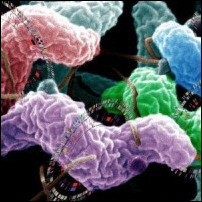
Campylobacter
|
Erin Price, from QUT's Faculty of Science, has developed a novel set of methods that uses genetic markers to pinpoint the bacteria Campylobacter jejuni.
"Campylobacter jejuni is the commonest cause of bacterial food-borne gastroenteritis in westernised countries," Ms Price said.
"It is more common than salmonella, yet most people have never heard of it."
Ms Price said although there were about 20,000 registered cases of the disease in Australia each year, scientists believed the real rate could be 10 times higher.
"The reason the rate is so low is that it rarely kills people and is self-resolving, so in many cases it is not diagnosed," she said.
"Symptoms include diarrhoea which can last anywhere from two days to two weeks."
Ms Price said despite the high rates of infection, it was still unknown exactly how the bacteria was transmitted to humans.
"We think that it is mainly transmitted in foodstuffs, and predominantly from improperly handled and undercooked poultry, although there are potentially many other sources of infection," she said.
"One hampering factor in detecting Campylobacter jejuni is the lack of standardised, routine, simple and cost-effective methods of fingerprinting or identifying the bacteria.
"What I have done is develop a systematic and novel genotyping method to be used by clinicians and scientists, which essentially creates a fingerprint of the bacteria using genetic markers.
"This fingerprint can then be used to characterise the bacterial strain present."
Ms Price's novel genotyping methods rely on software developed at QUT which identified genetic targets.
She said that by improving methods for characterising Campylobacter jejuni strains, clinicians and scientists were better able to monitor and understand the transmission of these bacteria to humans.
"If we can figure out where the bacteria is coming from we can look for ways of preventing its spread."
Ms Price, who has almost completed her PhD, said her study paved the way for improved diagnosis of Campylobacter jejuni as well as many other clinically significant infectious agents.
Further Reading
 |
- For more information on Campylobacter in poultry clicking here. |