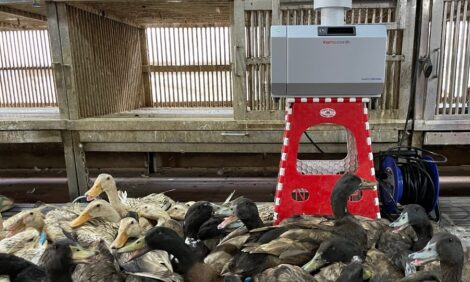






Case Study: Transforming Hatchery Operations with WingScan
“For my business, there is no future without this machine… in a few years you won’t find anyone doing manual sexing anymore.”
 13 July 2026
 3 minute read
 By:
By: For Capetta Hatchery in Neive, Italy, traditional manual chick sexing had become increasingly difficult to sustain. The business, owned and managed by Sergio Capetta, produces around 480,000 chicks each week – roughly 24 million chicks annually – and skilled labor was becoming harder to find.
Around ten workers were needed on the line, often working shifts lasting up to twelve hours. Even with this level of staffing, productivity remained limited and accuracy could vary as workers became fatigued.
Manual handling raised additional concerns about chick welfare. Chicks were handled multiple times during the process, increasing stress and the risk of trauma. Faced with these pressures, Sergio Capetta saw change as essential.
The solution
Capetta Hatchery implemented WingScan, an automated chick sexing system designed to increase throughput, improve accuracy, and reduce reliance on manual labor while enhancing animal welfare.
On the installation, Sergio Capetta said: “For my business, there is no future without this machine… in a few years you won’t find anyone doing manual sexing anymore.”
Implementation
The introduction of WingScan had a huge impact. Instead of ten workers carrying out manual sexing, the operation now runs efficiently with four to five people. One person loads crates onto the conveyor while three operators place chicks onto the line, allowing the machine to run continuously.
Hatchery Manager Domenico Torre described the new setup: “With 4 or 5 people, we can process a large number of chicks… the machine keeps running continuously at a steady pace.”
The system proved easy to adopt. As WingScan operator Erik Sarotto noted, “Interacting with the machine is very easy because it’s very intuitive… you immediately know where to act.”
Results
Productivity and Labor Efficiency
The most immediate impact was a significant increase in throughput. Output rose from approximately 15,000 to 16,000 chicks per hour to as many as 35,000 to 40,000 chicks per hour.
At the same time, labor requirements dropped. “Before, on the line, there were around 10 people… now on the line we have one person,” said Torre, referring specifically to the role of manual sexing.
Working hours were reduced by half. “Before the working day lasted 12 hours, now it is six hours, with the same numbers of chicks,” said Sergio Capetta.
Accuracy and consistency
WingScan delivered a major improvement in sexing accuracy. Error rates fell to around 1%. “The sexing now, in my opinion, is perfect… there is a 1% error, no more,” Capetta explained.
This improvement has also been confirmed on farms. Paolo Marenco shared that “there are no longer imbalances between males and females.”
Animal welfare improvements
Previously, chicks were handled multiple times throughout the process. With WingScan, that has been reduced to a single transfer step.“ Chicks experience much less trauma than before… now there is only one step, so the chicks are handled much less.”
Operators and customers have observed improvements in chick quality and lower mortality rates. Sarotto added, “they’re handled much less… there’s been a complete improvement in every area.”
Operational reliability and ease of use
Operators consistently report that the system is simple and reliable. The interface provides clear, real-time feedback on performance and alerts users to issues before they escalate.
Sarotto explained, “The machine alerts you to an error before it stops… intervention is quite immediate.” Most issues are minor and resolved in seconds, often with simple cleaning.
The system also captures detailed production data, allowing operators to monitor sex ratios, unclassified chicks, and machine performance throughout the day.
Marenco summarized the experience: “Everything is completely accessible in a very, very simple way… anyone can use it.”
Service and support
Support from the WingScan team has been proactive and dependable. The installation included training that enabled the team to manage maintenance independently.
Marenco noted, “They taught us how to handle maintenance… and they are always present and available for support.” In some cases, issues were identified remotely before production began and resolved quickly.
Outcome
The adoption of WingScan has fundamentally improved operations at Capetta Hatchery. The business now operates with higher productivity, greater accuracy, reduced labor dependence, and improved animal welfare outcomes.
As Sergio Capetta put it, “Everyone has found an improvement, everyone,” reflecting both internal gains and positive feedback from customers.
By transitioning to automated sexing with WingScan, Capetta Hatchery has addressed critical labor challenges while achieving measurable gains in efficiency, quality, and welfare. The move has positioned the business for long-term sustainability in an industry where manual sexing is becoming increasingly difficult to maintain.