






Gut health emerges as key strategy to fight broiler lameness
New synbiotic research shows up to 45% reduction in BCO, reinforcing the role of gut health and gut integrity in disease prevention
 7 April 2026
 7 minute read
 By:
By: Lameness remains one of the most persistent welfare and productivity challenges in modern broiler production. Genetic progress continues to push birds toward improved growth and feed efficiency, and the poultry industry must confront an unintended consequence: skeletal disorders that can impact bird welfare, performance and profitability.
Among these disorders, bacterial chondronecrosis with osteomyelitis (BCO) has emerged as one of the most significant causes of lameness in broiler chickens. First reported in the early 1970s, the condition has since become a recognized global challenge in commercial poultry production.
While visible lameness is the most obvious symptom, the disease often begins silently long before birds show clinical signs.
“Typically, about 1.5% of broilers in the United States and Europe show clinical signs of BCO, however, research in Northern Ireland indicated 17.3% of birds with lameness have BCO lesions,” said Philippe Tacon, Global Product Manager Microbials at dsm-firmenich Animal Nutrition & Health. “About 10% to 15% of broilers suffer from subclinical BCO which usually appears first in younger birds.”
The broader economic implications are substantial. Leg problems cost the commercial broiler industry between $80 to $120 million annually in the US alone.
BCO begins beneath the surface
BCO is a bacterial infection that affects the bones of rapidly growing broilers. Historically known as femoral head necrosis, the disease is now more accurately described as bacterial chondronecrosis with osteomyelitis because it can affect multiple skeletal structures.
The disease primarily targets the femur and tibia head — areas subjected to intense torque and shear mechanical stress as birds grow quickly.
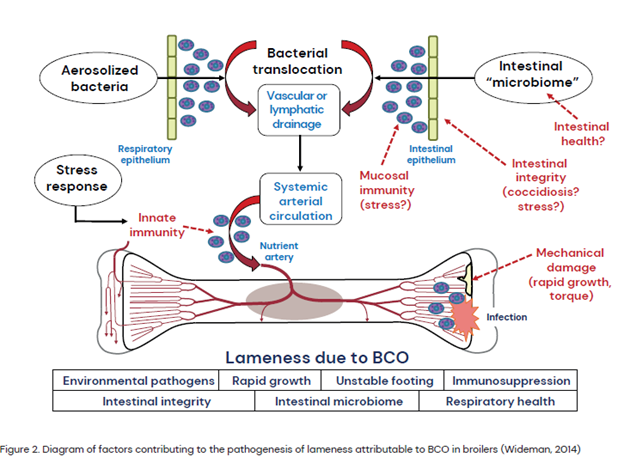
The process begins with structural weakness and damage in the growth plates of developing bones. Mechanical stress and rapid growth create small microfractures that allow bacteria circulating in the bloodstream to colonize these sites. Once established in these microfractures, the infection can progress rapidly. The bacteria grow rapidly and begin destroying bone minerals by releasing lytic substances at the site of colonization.
“The immune system has limited access to these damaged regions, allowing bacteria to proliferate. Over time, the infection leads to necrosis and inflammation resulting in bone degeneration and eventually visible lameness,” said Tacon.
One of the most challenging aspects of the disease is that it often goes undetected until birds begin to develop mobility problems. Thus, BCO lameness is entirely subclinical until the visual diagnosis of the bird.

Multiple factors contribute to BCO development
BCO doesn’t usually arise from a single trigger. Rather, it develops through a combination of biological, environmental and microbial factors.
“Rapid growth is no doubt one of the most significant drivers,” said Michaela Mohnl, Program Director at dsm-firmenich Animal Nutrition & Health. “The nature of modern broiler genetics emphasizes fast growth and high feed efficiency, which places increased mechanical stress on developing skeletal structures. However, growth rate alone is not the sole trait that determines susceptibility to BCO. We know that the fastest growing birds aren’t necessarily ultimately the ones that succumb to the disease.”
Environmental factors also play an important role. Poor footing, unstable flooring, high stocking density and stress can increase the likelihood of skeletal damage and infection.
Additionally, several bacterial species have been linked to the disease. Pathogens commonly associated with BCO include Staphylococcus aureus, Escherichia coli, Enterococcus species and other Staphylococcus species. These bacteria can circulate through the bloodstream and settle in vulnerable bone structures like cartilage.
Historically, antimicrobials have been used to treat bacterial infections associated with lameness. However, reliance on antibiotics presents challenges.
While certain antimicrobial treatments have demonstrated temporary effectiveness, their efficacy can decline over time. Antibiotic treatment has been shown to provide initial therapy but after 11 days the efficacy wanes. Thus, more effective treatment is needed that aligns with industry goals to reduce antibiotic usage.
Why the gut may be central to the problem
Recent research suggests that the gastrointestinal tract may play a more significant role in BCO development than previously understood. Enteric bacteria can move from the gut into the bloodstream through a process known as bacterial translocation.
“How it works is the enteric bacteria can move from the intestine into the systemic circulation. Once these bacteria enter the circulation, they can reach the capillaries that irrigate the bones,” said Mahdi Ghanbari, Microbiome Host Interaction Lead at dsm-firmenich Animal Nutrition & Health.
This realization has shifted attention and research toward gut health as a potential strategy for reducing BCO incidence.
A microbiome-focused approach
Researchers are increasingly exploring nutritional and microbiome-based strategies to strengthen the bird’s natural defenses against infection. One promising approach involves the use of synbiotics – combinations of probiotics and prebiotics designed to support beneficial intestinal microbes.
Probiotic bacteria may help prevent BCO by improving intestinal health, strengthening the mucosal barrier and reducing bacterial leakage into the bloodstream.
Probiotics can interfere with disease development by:
- reducing populations of pathogenic bacteria in the gut
- improving gut barrier function
- reducing bacterial translocation across the intestinal wall
- priming the immune system to eliminate pathogens more effectively
Lactic acid bacteria, especially from Bifidobacterium and Lactobacillus spp, have been identified as particularly important for poultry gut health.
“Probiotic species from these genera are included in PoultryStar® – a well-defined, poultry-specific, multispecies synbiotic that could offer a potential solution for BCO lameness mitigation,” said Ghanbari. “These microbes help maintain a stable intestinal ecosystem that limits the growth and movement of harmful bacteria.”
Lameness research offers solution
Studying BCO in experimental conditions has historically been difficult because natural incidence rates are relatively low in research flocks. To overcome this challenge, scientists developed specialized models to reproduce the disease reliably.
One widely used system involves raising birds on wire flooring. The unstable footing increases mechanical stress on the legs, creating conditions that promote skeletal damage and infection.
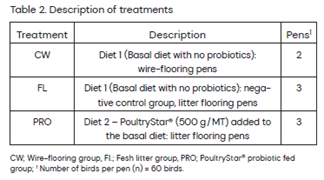
The wire-floor system was used to conduct a series of experiments to study the feed effect of PoultryStar® to manage and reduce the incidence of BCO lameness. In the experiments, the synbiotic was supplied in feeds from 1 day through up to 56 days of age. The results showed that PoultryStar consistently helped to reduce the incidence of clinical lameness in broilers raised on wire flooring in four statistically significant experiments.
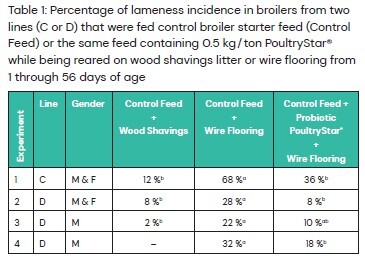
“PoultryStar was shown to work by interfering with bacterial translocation into subclinically damaged voids or clefts in the proximal femoral and tibial epiphyseal plates,” said Mohnl. “Bacterial translocation from the gastrointestinal tract is likely to be a significant route contributing to the spread of the infection through the bloodstream.”
More recently, researchers have developed another experimental approach that mimics horizontal spread in commercial production environments.
This model uses “seeder birds” that harbor BCO-causing pathogens. These birds are placed in wire-floor pens where bacteria can spread to other birds through ventilation airflow, simulating horizontal transmission in a poultry house.
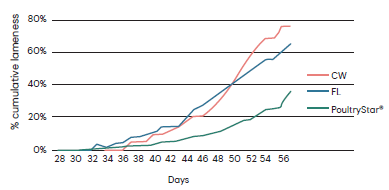
A new trial tested the efficacy of PoultryStar again from day 1 to day 56. Feeding PoultryStar showed a decrease in the incidence of BCO by nearly 45% after 56 days. Mortality in the treatment group (56%) was also significantly reduced by 40% compared to the control group (87%).
Researchers observed that birds receiving PoultryStar maintained stronger intestinal barrier function during bacterial challenges. Gene expression analysis revealed improved levels of key tight-junction proteins that help maintain gut integrity. These proteins play a critical role in preventing bacteria from crossing the intestinal wall.
Field trials confirm commercial consistency
Beyond laboratory studies, synbiotic strategies have also been evaluated under commercial conditions.
- United States: Four field trials conducted in the US demonstrated consistent reductions of 30% in BCO lameness when PoultryStar was administered through drinking water.
- The Netherlands: A trial repeated for two production cycles from two different breeder farms showed improved daily weight gain and lower lameness rates in treated birds along with lower slaughterhouse rejections.
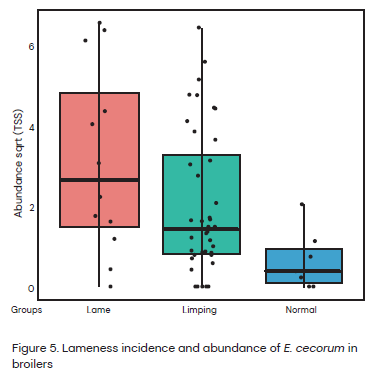
- Thailand: A more extensive trial was performed at an integrator using four farms in two different locations where the synbiotic was administered in the feed for the whole growing period (39 days). The results showed a decrease in lameness incidence of more than 20% on two farms. Furthermore, a strong correlation between lameness status and the Enterococcus cecorum abundance was seen. The abundance of E. cecorum was reduced by PoultryStar feeding treatment both in femur and tibia samples.
Creating healthier flocks and sustainable production
BCO remains a multifactorial disease influenced by growth rate, bacterial exposure, environmental conditions and immune status. However, emerging evidence suggests that maintaining intestinal health may be one of the most effective ways to reduce the disease.
Improving gut integrity and microbial balance can help prevent the bacterial translocation that allows pathogens to reach skeletal tissues. Growing pressure to reduce antibiotic usage while maintaining productivity and animal welfare means microbiome-based strategies are becoming an increasingly important tool for poultry producers.
Strengthening gut health could ultimately help the industry produce stronger birds, healthier flocks and more sustainable poultry production systems.
Learn more about BCO lameness in broilers.


Sarah Mikesell
Sarah Mikesell grew up on a five-generation family farming operation in Ohio, USA, where her family still farms. She feels extraordinarily lucky to get to do what she loves - write about livestock and crop agriculture. You can find her on LinkedIn.