





How Ceva's C.H.I.C.K Program made hatchery vaccination quality a daily reality
10 years of quality recognition in poultry health and hatchery management.
 8 June 2026
 7 minute read
 By:
By: Key takeaways
- Ceva's C.H.I.C.K Program has supported hatchery vaccination quality worldwide for 17 years and has maintained independent Quality Recognition by Bureau Veritas since 2016.
- The program is implemented through a global network of more than 210 qualified hatchery vaccination specialists operating under standardized procedures and audited quality controls.
- Over the past 10 years, more than 70,000 hatchery vaccination audits have been conducted across nearly 100 countries, generating one of the poultry industry's largest operational datasets on hatchery vaccination quality.
- Annual quality audits currently cover 35 countries or regional clusters, demonstrating ongoing compliance with the C.H.I.C.K Program Quality Code of Practice.
- Data collected between 2021 and 2025 shows consistently high vaccination quality across all major day-old vaccination technologies:
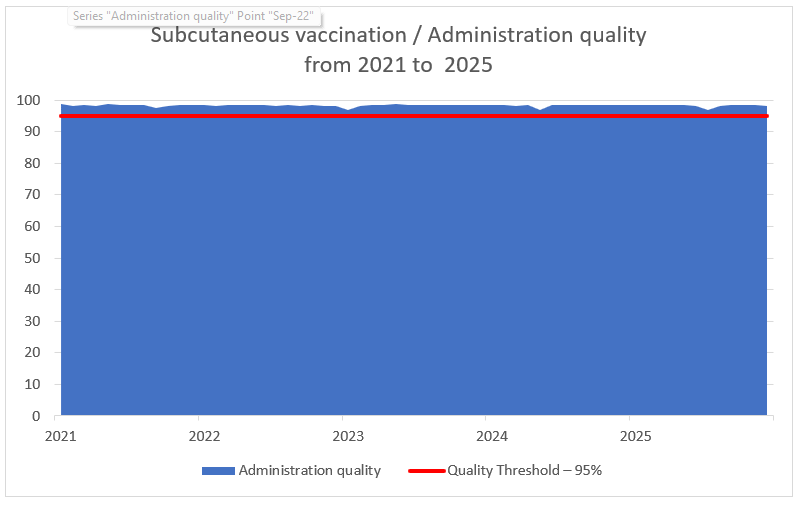
- Subcutaneous injection: consistently above 95% quality
- Spray vaccination: consistently above 95% quality
- Gel application: above 97% quality
- The program focuses on five critical control points: vaccine preparation, dose accuracy, vaccination quality, equipment maintenance and operational excellence through staff training.
- Continuous monitoring, preventive equipment maintenance, operator training and data-driven performance management help reduce vaccination errors, minimise vaccine waste and improve process consistency.
For the past 17 years, Ceva Animal Health's C.H.I.C.K Program (Chick Hatchery Immunisation Control Keys) has helped hatcheries implement and monitor these essential elements. Supported by more than 210 specialists worldwide and backed by over 70,000 audits across nearly 100 countries, the program combines field expertise, technology and data-driven monitoring to improve vaccination consistency and performance.
This year marks an important milestone: 10 years since the C.H.I.C.K Program became the first hatchery vaccination service in the animal health industry to achieve international Quality Recognition by Bureau Veritas.
It started with a simple ambition: 100% of chicks well-vaccinated at the hatchery, ensuring optimal animal health and production performance from day one.
Started in 2009, Ceva Animal Health's Chick Hatchery Immunisation Control Keys - C.H.I.C.K Program hatchery vaccination service has been proposed to hundreds of hatcheries around the world, supported by dedicated teams of specialists in poultry vaccination, equipment, technologies and animal health services.
About four years later, innovative technologies and vaccination equipment were introduced to facilitate monitoring activities across hatchery sites. This marked a new step forward in hatchery vaccination processes, combining field expertise, operational control, and data-driven practices to improve quality, consistency and overall production performance.
In 2016, Ceva became the first in the animal health industry to have this hatchery vaccination program Quality Recognized internationally by Bureau Veritas.
From this moment, Ceva made available the C.H.I.C.K Program Quality Code of Practice to its affiliates, providing clear procedures, technical information and best practices for the control of hatchery vaccination in poultry production across different countries and production environments.
That turning point was important as it validated years of field experience, training, and standardized practices carried out by dedicated teams worldwide.
It also provided customers with strong reassurance, as an independent body reviewed the services provided and confirmed alignment with a strict, documented quality framework, operational processes and industry practices.
Today, after 17 years, Ceva’s C.H.I.C.K Program stands as a global reference in hatchery vaccination services, designed to optimise vaccine storage, vaccine preparation, administration processes (including injection, spray and in-ovo vaccination), equipment handling and operational control, as well as training of hatchery teams and field operators.
The ambition became a Quality Recognized way of working—standardized, audited, and continually improved. The 35 countries or clusters passing quality control audits every year demonstrate compliance with international standards while reinforcing performance, quality and consistency across hatcheries worldwide.
This year, we are proud to celebrate 10 years of Quality Recognition for Ceva’s C.H.I.C.K Program—a milestone that highlights both the robustness of the program and the long-term commitment behind it, supporting the poultry industry worldwide.
Understanding quality recognition in hatchery vaccination
Bureau Veritas recognizes how the C.H.I.C.K Program Quality Code of Practice is implemented, specifically the way hatchery vaccination processes are managed, monitored, controlled and continuously improved across different operational contexts.
This includes clearly defined procedures, documented steps, operational monitoring, and continuous improvement practices aligned with animal health requirements, regulatory expectations and industry standards.
The Code of Practice is built around four pillars that customers experience in their daily hatchery operations:
- Qualified teams dedicated to monitoring in-ovo and day-old chick vaccination quality
- Continuous training for hatchery operators (covering vaccine storage, handling, preparation, administration, injection techniques, equipment maintenance, and performance tracking)
- Preventive maintenance of vaccination equipment
- Regular hatchery visits to ensure process control, consistency and continuous improvement
These pillars structure the way Ceva teams operate worldwide, ensuring best practices are applied consistently across all hatchery sites, production systems and operational environments.
Ceva’s C.H.I.C.K Program hatchery services and vaccination practices
Ceva’s C.H.I.C.K. Program delivers standardized and high-quality hatchery vaccination services worldwide, supporting hatcheries with reliable processes, advanced technologies and strong field expertise.
Through a global network of more than 210 qualified specialists, the program is implemented via regular hatchery visits conducted in accordance with strict Standard Operating Procedures (SOPs). These procedures ensure consistency across countries, sites and production systems while maintaining high levels of quality, control and operational performance.
These visits focus on five key control points:
- Proper vaccine preparation
- Accurate dosing for every chick
- Correct vaccination of each bird
- Well-maintained equipment
- Excellence in operational practices and staff training
By rigorously applying these practices, the program ensures that every chick leaves the hatchery properly vaccinated, supporting animal health, production performance and consistency across poultry operations.
Its philosophy is simple: measure, share, improve. Thanks to regular field visits, digital tools and the C.H.I.C.K Program application, hatcheries receive real-time information, enabling better process control, benchmarking and continuous improvement across the poultry industry.
For hatcheries and integrators, these results translate into healthier chicks, improved production outcomes and more sustainable poultry operations, while reducing vaccine waste and optimizing overall performance.
Performance Results 2021–2025: Evidence from more than 70,000 hatchery audits
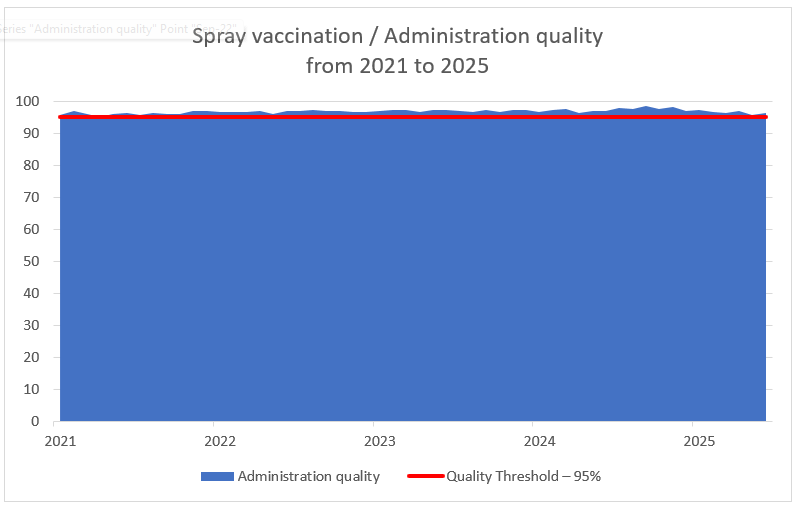
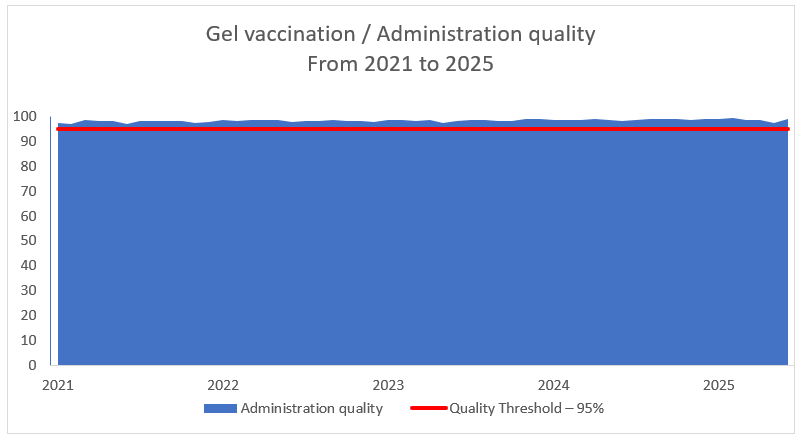
The C.H.I.C.K Program's commitment to measurement and continuous improvement is reflected in the extensive operational data collected across hatcheries worldwide.
Between 2021 and 2025, performance data generated through regular hatchery assessments demonstrated consistently high levels of vaccination quality across the three principal day-old vaccination technologies. The analysis is based on KPIs collected during routine hatchery visits conducted under standardized operating procedures.
Subcutaneous injection
Subcutaneous injection maintained quality performance consistently above 95% throughout the period. Monitoring focused on critical indicators including injection site accuracy, dose delivery and vaccine retention. Error rates associated with missed injections, incorrect administration sites and vaccine leakage remained low, demonstrating strong process control and equipment performance.
Spray vaccination
Spray vaccination also achieved quality results above 95%, reflecting consistent vaccine distribution and uniform chick coverage. Performance was supported by regular equipment calibration, operational monitoring and ongoing operator training.
Gel vaccination
Gel-based vaccine administration delivered the highest recorded performance levels, exceeding 97% quality. Results indicate highly consistent vaccine uptake and reliable application, helping support effective early-life protection.
What the data shows
The results highlight three factors that consistently influence hatchery vaccination success:
- Standardized operating procedures
- Well-maintained vaccination equipment
- Continuous operator training and competency development
Across all vaccination technologies, the data demonstrates that structured monitoring and process control can deliver high levels of consistency at scale.
2021–2025 Performance summary
Subcutaneous Injection >95%
Spray Vaccination >95%
Gel Vaccination >97%
Based on more than 70,000 audits conducted across nearly 100 countries, these findings provide a robust evidence base for the role of quality management systems in improving hatchery vaccination outcomes worldwide.
Ten years on: what we’ve learned in hatchery vaccination operations
1. Making quality a daily routine through consistent field visits
Regular visits from Ceva specialists integrate quality into everyday hatchery operations. Because practices are standardized worldwide, multi-country poultry producers can rely on consistent methods across all sites, ensuring operational alignment, control and performance.
2. Strengthening data-driven decision making
Access to clear and actionable information allows hatchery managers to identify trends, adjust processes quickly and improve vaccination performance, operational control and efficiency.
3. Training scales trust and consistency
Continuous training ensures that hatchery teams apply the same high standards everywhere, regardless of country, operational context or regulatory environment, supporting consistent animal health and production outcomes.
Looking ahead: the next decade of hatchery vaccination innovation
Quality Recognition is not an endpoint—it is part of a continuous improvement process. As the poultry industry evolves, Ceva continues to develop its hatchery vaccination program around three priorities:
- Hatchery data solutions
Advanced data collection and analysis to better anticipate issues, strengthen process control and support operational decision-making across hatcheries - Hatchery technology and equipment innovations
Continuous improvement of vaccination equipment and technologies to meet evolving industry needs and enhance performance - Partnerships and compliance
Maintaining alignment with regulatory requirements, field practices and international standards through independent audits, structured procedures and continuous improvement initiatives
A shared celebration across the poultry industry
This milestone is also a celebration of customers, hatcheries and partners worldwide who apply best practices in hatchery vaccination and operational excellence.
Their commitment contributes to better animal health, improved poultry production performance and long-term sustainability across the global industry.
Thank you
To all teams involved—field specialists, trainers, auditors, data analysts, equipment experts, hatchery operators and customers—thank you.
Your work ensures that this hatchery vaccination program delivers consistent quality, reliable processes, strong performance and measurable results worldwide.
For more information, readers can contact Ceva or visit the official website to access additional content and services.
Notes on recognition wording and scope
The C.H.I.C.K Program’s Quality Recognition by Bureau Veritas relates to compliance with the Quality Code of Practice for hatchery vaccination services.
This recognition confirms that processes, procedures and practices are properly defined, implemented, documented and controlled in line with international standards, regulatory expectations and animal health requirements.