





New Frontiers in Poultry Production: Brett Roosendaal on what drives poultry decision-making and profitability at Rainbow Chicken
At Rainbow Chicken Farms in South Africa, the scale is immense – and the stakes are high
 6 January 2026
 7 minute read
 By:
By: At Rainbow Chicken Farms, one of South Africa’s largest integrated poultry operations, profitability is the metric that guides every production and nutrition decision. With nearly 30 million birds on the ground at any given time, the organization relies on disciplined data analysis, precision nutrition and targeted health strategies to deliver performance at scale.
That responsibility sits with Brett Roosendaal, commercial nutrition executive at Rainbow Chicken Farms and speaker at New Frontiers in Poultry Production, an exclusive poultry industry conference hosted by EW Nutrition in Hurghada, Egypt. He spoke on the real-world challenges facing modern poultry producers and the levers that matter most as an integrated business.
“Any of the decisions that I make, we look at the money first. And for me that's the most critical part of my job. That's my biggest challenge,” he said.
In his view, nutrition is not merely a cost line or formulation exercise – it is the central driver of business performance. Roosendaal outlined Rainbow Chicken’s approach to feed valuation, early development, antimicrobial policy, breeder performance and additive selection, which are all grounded in measurable returns rather than theoretical standards. He emphasized the need for practical, evidence-based thinking in an environment where assumptions and trends can easily distort priorities.
Optimizing feed valuation to avoid “average performance”
Roosendaal opened his presentation by explaining that the foundation of profitable poultry production begins with an accurate feed valuation system that reflects real performance outcomes, not industry-average estimations. Rainbow Chicken originally relied on nutrient models such as NRC, INRA and CVB, averaging their published values into a single table. This is a practice that Roosendaal now strongly discourages.
“When I started my career, we looked at all of these models to build our feed valuation system. Absolutely the wrong thing to be doing, because you just get average performance ultimately,” he said.
Instead, Roosendaal worked with his team to develop its own internal dataset built from real production response curves tied to energy, amino acid digestibility and live performance outcomes. The company also carefully standardizes ileal digestible amino acid profiles and captures detailed economic response metrics at different energy levels. These internal response curves allow Rainbow Chicken to model the financial impact of small formulation adjustments and determine exactly where profit peaks.
“For me, the cheapest cost of a kilogram of broiler meat is our objective for the company,” Roosendaal said.
This economic lens guides everything from raw material procurement to formulation strategy. Roosendaal purchases feed ingredients three to six months in advance, giving clear visibility into future cost pressures and opportunities to optimize around them but only if supported by data.
Reflecting on FCR variation across farms in recent cycles, he said, “You need to be looking into data analyzing this, trying to use these farms to figure out what's going wrong and creating the variation.”
Identifying outliers and diagnosing root causes enables interventions that deliver immediate operational value.
Gut health: Critical in the first days and impossible to fix later
Beyond formulation, Roosendaal identified gut integrity as the most important biological driver of broiler performance. According to research he referenced, the majority of lifetime gastrointestinal development occurs extremely early in life – a brief window where mistakes become permanent.
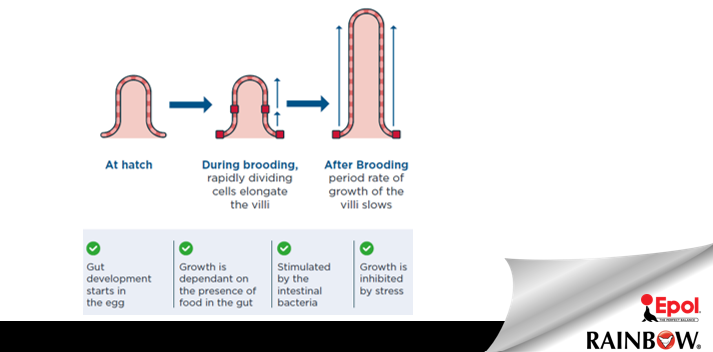
“Brooding is so critical to the life of a broiler,” he said. “You don't get compensatory growth of villi, so if you don't get it right in brooding, the flock is going to suffer.”
To evaluate early uniformity, Rainbow Chicken targets a minimum of 4.5 times hatch weight by seven days, and tight coefficient of variation (CV) values to indicate consistency. But Roosendaal cautioned that numerical results cannot replace hands-on evaluation, insisting that producers must be physically examining birds.
“How do you know you've got a gut problem? You've gt to be walking through the broiler houses regularly to see what's going on and what’s in the litter,” he said.
He noted that relying solely on laboratory metrics or pathology reports risks intervening too late to reverse damage, particularly given Rainbow Chicken’s short broiler production window, where birds are typically processed around 30 days of age.
“You can't make mistakes because you can't fix it – it's too short a timeframe,” he said.
The role of antibiotics and retail pressure on antimicrobial resistance
Roosendaal addressed rising global pressure to eliminate antibiotics – particularly from large retail and quick-service restaurant (QSR) buyers. He explained that Rainbow Chicken follows WHO guidance to avoid using classes of antimicrobials that are important to human medicine. However, he warned strongly against extreme policy shifts that could jeopardize feed efficiency, animal welfare and food security.
He referenced malnutrition rates among South African children as a stark reminder of the consequences of restricting access to affordable protein.
“In South Africa, we have 27% malnutrition with children under the age of five. This is because they can't afford protein in their diet,” he said.
Roosendaal expressed concern that well-intentioned but unrealistic antibiotic bans – like “No Antibiotics Ever” (NAE) programs – increase production costs, reduce sustainability through lower efficiency and ultimately restrict access to nutritious food for those who need it most.
He pointed to the US market experience, where production costs have been reported to rise significantly under NAE systems and some food companies have pulled back from their NAE stances.
Ultimately, he challenged the current antibiotic regulations and raised concerns about those who would like to implement even more regulations.
Rearing profiles: Driving profit through heavier breeders
Roosendaal also discussed research into broiler breeder rearing programs, noting that producing heavier breeder females results directly in heavier eggs and heavier day-old chicks, with downstream economic advantage for integrated companies.
“Heavier breeders produce heavier eaters,” he said.
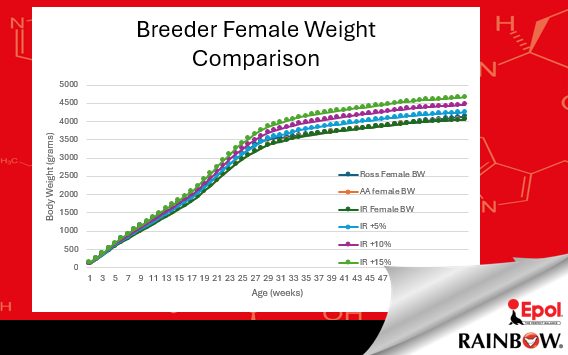
Rainbow Chicken is currently evaluating breeder growth curves that are 5%, 10% and 15% above recommended standards and has seen some measurable improvements in egg weight.
Roosendaal noted that historically, breeder feeding programs were rooted in feed restriction to manage reproductive efficiency, but modern genetic progress requires updated thinking. He urged integrators to evaluate growth strategies independently and cautioned against assuming genetic company recommendations represent optimal commercial performance.
“You need to go and do your own research,” he said. “Many genetics company recommendations haven’t been updated for 20 to 25 years, but the birds have changed. So do your own studies and see what works on your farm.”
Feed additive strategy: Demand proof, not promises
Roosendaal devoted significant time to the challenge of selecting additives, including enzymes, probiotics, essential oils, organic acids and other ingredients with claimed gut health benefits. While producers often look to additives to solve performance challenges, he argued that many products lack repeatable efficacy under real production environments.
“For me the mode of action is critical. Can additive companies explain to me how it works and why it works. If not, I'm not interested,” he said. “Second point: I want local data of how your product works.”
He noted that trial repeatability is often weak and that success is highly dependent on farm environment, microbiota profile, substrate availability and stress context.
“Gut health is a journey, not a destination,” he said. “What worked yesterday may not work today. A lot of continuous improvement and tinkering are required. Measure everything – performance, gut health and gut microflora.”
When economics tighten, producers frequently reconsider additive cost, but Roosendaal cautioned against indiscriminate removal.
“Ask – why did we include the additive in the first place? Does the problem still exist? Does it still work, and is it cost-effective? Only then should we consider making a change,” he said.
Partnership alignment is also essential.
“I can't have five different opinions in the room,” he said. “I want partners who know what my objectives are and what I need to do and how to get there.”
Microbiome mapping and what’s next for gut health science
Roosendaal expressed enthusiasm for microbiome sequencing technologies that track bacterial populations and metabolic interactions and may allow targeted manipulation of gut communities. While Rainbow Chicken is investing in data collection and experimental insight, he acknowledged that the industry does not yet fully understand how to convert sequencing outputs into nutritional strategies.
“I'm confident in building this information and knowledge will reap benefits in time to come,” he said.
For now, progress comes from disciplined experimentation and continuous improvement.
“Again, it's a journey. What we're just saying might not work today. But we are after repeatability and results. It’s pretty cool,” he said. “We've got to play a bit. Test, check, experiment.”
Roosendaal’s perspective
Across feed valuation, gut health, breeder management, additive assessment and antimicrobial stewardship, Roosendaal’s perspective is consistent: profitability and performance depend not on industry averages or trends, but on precision, measurement and accountability.
By focusing on response-driven nutrition, data discipline and early-life management, Rainbow Chicken aims to maintain efficient production while responding to market pressure and protecting food access for South Africans.
In a rapidly changing global poultry environment, Roosendaal’s call to action remains clear: evaluate rigorously, measure constantly and never assume that yesterday’s solutions are good enough for tomorrow.


Sarah Mikesell
Sarah Mikesell grew up on a five-generation family farming operation in Ohio, USA, where her family still farms. She feels extraordinarily lucky to get to do what she loves - write about livestock and crop agriculture. You can find her on LinkedIn.