





New Frontiers in Poultry Production: Finding the X-Factor behind your poultry intestinal diseases
Polish diagnostician Dr. Jaroslaw Wilczynski says to look beyond symptoms, analyze the data and admit where things go wrong
 20 November 2025
 7 minute read
 By:
By: Dr. Jaroslaw Wilczynski, head of the Veterinary Diagnostic Laboratory in Poland and associate professor at the Polish Academy of Sciences, spoke recently at EW Nutrition’s conference New Frontiers in Poultry Production. The event gathered 250 partners, customers and peers from 40 countries in Hurghada, Egypt.
Enteric diseases remain among the costliest and most persistent challenges in poultry production, yet the mechanisms behind many intestinal disorders are often hidden in plain sight. Dr. Wilczynski believes solving those mysteries requires a blend of field observation, diagnostics and humility.
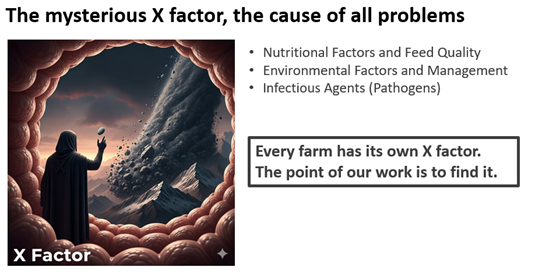
“Every farm has its own X-factor,” Wilczynski explained. “The point of our work is to find it.”
Understanding the gut’s “hidden brain”
Poultry metabolism, he said, is uniquely fast and finely tuned, making the digestive tract both a chemical and biological engine. The proventriculus acts as “a chemical machine,” while the muscular stomach functions as “a biological mill.” That complexity, coupled with high cell turnover of every two to five days, means that even minor disruptions can cascade into serious performance losses.
The intestinal environment hosts about 640 microbial species, dominated by Firmicutes, Bacteroidetes and Proteobacteria. Maintaining balance among them is crucial.
“I always imagine the microbiome as a big city,” Wilczynski said. “Everyone wants food at the same time. But when bad gangs take over one district, the city is ruled by them. That’s dysbiosis.”
Healthy microbial diversity protects intestinal integrity – what he calls the system’s ability to “let in what is good and block out what is bad.” When that barrier breaks, feed conversion, weight gain and vaccine response all decline, while pathogen pressure and veterinary costs climb.
Hidden costs of gut disease
Wilczynski emphasized that the true cost of enteropathies goes far beyond visible production losses.
“It’s easy to calculate feed conversion, average daily gain or mortality,” he said, “but the most important for me are the hidden costs.”
These include poor litter quality, leg dermatitis, elevated ammonia, reproductive problems and weak post-vaccination reactions which are all symptoms of systemic intestinal stress. Each adds quietly to the bottom line through medication, service and slaughterhouse contamination expenses.
He calls such problems the “heightened costs” of intestinal disease: pervasive, under-measured and often ignored.
Searching for the X-factor
According to Wilczynski, every gut problem begins with a single disturbance – “there’s a small stone that starts the avalanche.” That X-factor can be nutritional, environmental, managerial or infectious.
“The key point is to find this X-factor,” he said. “It’s different for every farm, every case. But once you find it, you can solve the problem.”
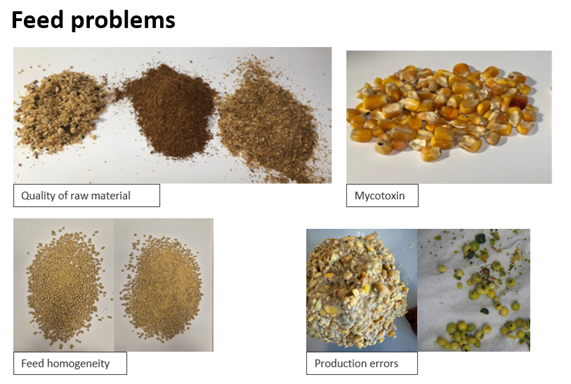
His lab’s data in Poland show just how diverse those triggers can be. Feed composition, for example, is a frequent culprit. In 2024, the lab found multiple mycotoxins in their samples, with deoxynivalenol leading (60%), followed by zearalenone (30%) and T-2 toxins (8%).
Particle size also matters: “Almost 60% of samples had fractions below 2 millimeters,” he noted. Fine or dusty feed leads to uneven nutrient distribution, encouraging selective feeding and intestinal irritation.
Birds, as granivores, seek out pellets as their main food. These pellets contain significantly fewer nutrients, which causes secondary deficiencies like protein and minerals. The dusty fraction is eaten last. This fraction contains significantly more nutrients and little fiber, which inhibits intestinal peristalsis, ultimately leading to dysbacteriosis. This condition facilitates the growth of potentially pathogenic bacteria (e.g., Clostridium).
Water quality - the overlooked variable
Water can also be a hidden source of disease. Samples arriving at his lab often test positive not only for Salmonella but also E. coli, Staphylococcus, Enterococcus and even Candida.
“Remember,” he warned, “when you start looking for the X-factor of disease, start with the water. It should be on top of the list.”
Poor-quality water supports bacterial biofilms and undermines vaccine uptake, compounding intestinal stress across the flock.
Viruses open the gate for bacteria
Wilczynski described enteric viral infections as “the silent openers of the gate.” His 2024 data show that 93% of viral outbreaks were poly-etiologic, involving combinations of rotavirus, astrovirus and coronavirus. Only 7% were single-virus cases.
“The main symptom is wet litter,” he said. “They are most dangerous for young birds and open the gate for bacteria. These viruses are extremely resistant in the environment.”
He cautioned that standard disinfection is often inadequate.
“Everything contaminated by feces – feeders, safety boots, even cars – must be cleaned,” he said. “Otherwise, it becomes the source of future contamination.”
Bacteria and the “Vicious Circle”
Once the microbial balance is disturbed, bacteria quickly seize the opportunity. Clostridium perfringens, the causative agent of necrotic enteritis (NE), is a normal intestinal resident that becomes deadly when overgrown.
“Everything starts with the mysterious X-factor,” he said. “Maybe dusty feed, maybe stress, and it promotes anaerobic bacteria. Then inflammation begins, digestion stops and the vicious circle starts.”
NE is particularly costly. Wilczynski calls it “the silent killer,” fueled by diet and often intertwined with coccidiosis or parasitic infections. His lab’s 2024 figures confirm that Clostridium cases occur not only in broilers but also in commercial layers – a trend he finds alarming.
“For me, it was a surprise,” he said. “A lot came from layers. I saw catastrophic outbreaks where all feed in the layer house was contaminated.”
Among tested Clostridium strains, 100% carried alpha-toxin genes, while only 5% had NetB toxin genes, suggesting multiple virulence pathways.
The stealth of colibacillosis
E. coli presents another diagnostic challenge. He said not all strains are harmful – most are silent roommates – but a small, minority (avian pathogenic E. coli or APEC) exploit weakened birds. He explained their virulence, “The answer is simple—because they can. They have weapons.”
These “weapons” are virulence-associated genes (VAGs) that enable tissue invasion, serum resistance and iron scavenging. Genes like iss, tsh, irp2 and papC act as molecular tools that let E. coli colonize air sacs, liver or even skin. Horizontal gene transfer allows one strain to “borrow” another’s arsenal, it’s sort of “like going to a party and exchanging weapons,” he explained.
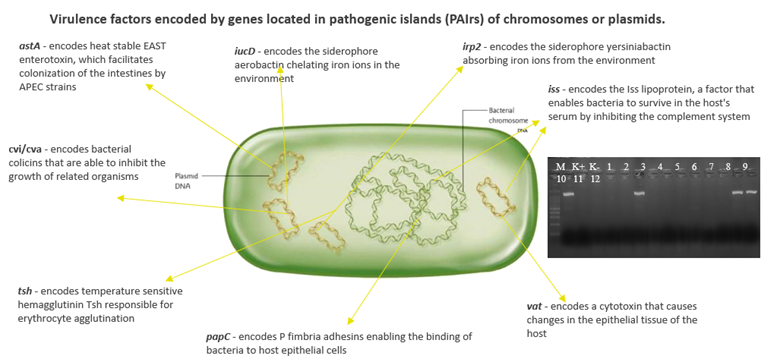
In an experiment using cloacal swabs from healthy broilers aged 18–24 days, his lab detected several APEC-associated genes, including iss.
“So yes, healthy birds can be a source of contamination,” he said. “That’s why understanding these genes is so important.”
Coccidiosis and parasites are gateways
Coccidiosis remains, in his words, “a disease of the entire flock.” Subclinical infections, meaning those without obvious mortality, are the most expensive. Routine monitoring using oocysts per gram (OPG) counts and scoring intestinal lesions is essential.
“Numbers don’t lie,” he emphasized. “But you have to compare numbers with numbers – from different houses, previous exams, different weeks – only then do you see the truth.”
His data show 26% positive coccidiosis samples in 2024, a figure he expects will rise. Histomoniasis, or blackhead disease, also re-emerged in several broiler and layer farms.
Post-antibiotic era requires prevention over cure
As antibiotic restrictions tighten, Wilczynski advocates a structured, data-driven approach.
“Biosecurity is the foundation of herd health. Monitoring is power. Prevention instead of cure,” he said.
Future tools include microbiome analysis, targeted vaccination and next-generation additives such as bacteriophages, antimicrobial peptides and toll-like receptor agonists.
Yet, he warns against chasing trends without diagnosis.
“First you have to find your problem,” he said. “Maybe half of the products on the market are not for your problem. Check all your data, set up your own field trials and analyze the results.”
He stressed that producers must “assess where your weak point is whether it be feed, hygiene or biosecurity.” Only then can interventions be effective.
Let data bring clarity
Throughout his presentation, Wilczynski returned to one recurring principle: objective measurement.
“As I said, numbers don’t lie. Only data speaks for itself,” he said.
For him, laboratory monitoring is not about blame but about clarity. Each OPG count, each microbial profile, each feed test tells part of the story. The challenge is connecting those data points to find the elusive X factor that starts the problem.
Humility and the human factor
Perhaps his most candid reflection came at the close of the session.
“To find the X-factor, first we must say we did something wrong,” he said. “Everybody says they’re doing a great job. But if that’s true, why do I see so many dead birds in my post-mortem room?”
That humility, he believes, is essential to progress.
“My ego, my job – vaccination, nutrition, cleaning – it all has weak points,” he said. “If you understand and admit this and catch it, you will have success. You will put all your energy into the real problem.”
Take-home lessons
From his field experience and diagnostic research, Wilczynski offers a clear roadmap for poultry professionals:
- Identify the X-factor. Each farm’s challenge – be it feed, water or pathogen – differs.
- Diagnose before treating. Use repeatable methods such as OPG counts, lesion scoring and microbiome analysis.
- Base decisions on data. Track trends across flocks and time.
- Prioritize biosecurity. Stop pathogens before they enter the production cycle.
- Find your weakness. Admit and accept that you are doing something wrong and fix it.
Ultimately, Wilczynski sees gut health not as a collection of isolated diseases but as a connected ecosystem. Each disturbance whether nutritional, microbial or managerial, sets off ripples that reach feed efficiency, welfare and profitability.
“The intestine,” he said, “is like a big city. Keep peace among its citizens, and the whole organism thrives.”


Sarah Mikesell
Sarah Mikesell grew up on a five-generation family farming operation in Ohio, USA, where her family still farms. She feels extraordinarily lucky to get to do what she loves - write about livestock and crop agriculture. You can find her on LinkedIn.