




Understanding gut health enhancement products
An overview and comparison of probiotics, acids, enzyme enhancers and more. 5 January 2026
 5 minute read
 By:
By: Produced as part of Aviagen's new Broiler Gut Health Toolkit
Each element of the Toolkit is designed to be used on its own or as part of a comprehensive training and management program:
- Focus Document: Antibiotic-Free and Reduced Antibiotic Use in Broiler Production: Gut Health
- Expert Presentation: Delivered by Dr. Richard Bailey, Aviagen’s Head of Applied Physiology, and a leading voice in poultry immunology and microbiology
- Aviagen Brief: Understanding Gut Health Enhancement Products
- Educational Poster: Gut Health on the Farm – a practical, visual guide for farm teams
- Interactive Guide: Step-by-step advice for implementing gut health best practices
Introduction
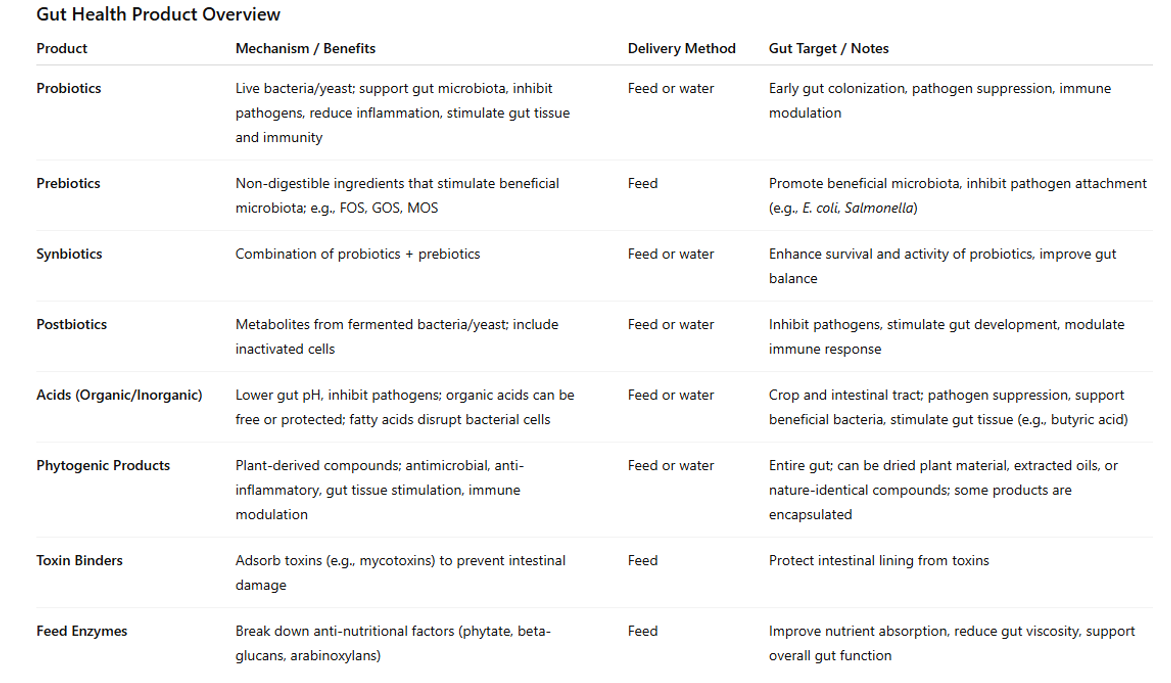
Gut health is vital for poultry growth, welfare, immunity, and disease resistance, relying on efficient digestion, gut development, and a balanced microbiota. With reduced antimicrobial use, controlling pathogens like Clostridium perfringens has become a focus. Gut enhancement products support digestion, immune and gut development, and microbial balance, but their effects vary. Evaluating and selecting the right product requires understanding its mode of action and consistent application over time.
Probiotics in poultry
Probiotics are widely used gut health enhancers in poultry, though the variety of available products can cause confusion. They are live microorganisms—commonly Bacillus, Bifidobacterium, Enterococcus, Lactobacillus, Pediococcus, or yeasts such as Saccharomyces—that support host health when delivered via feed or water. Importantly, different strains within the same species can act in distinct ways, such as promoting gut tissue development or suppressing pathogens. For this reason, the effectiveness of a probiotic depends on its specific strain and mode of action, and product choice should be based on defined objectives rather than a one-size-fits-all approach.
Probiotics and pathogen inhibition
Certain probiotic strains help protect poultry by inhibiting harmful pathogens. They compete with pathogens for nutrients and attachment sites in the gut, produce antimicrobial compounds (e.g., bacteriocins, organic acids), and lower gut pH to create an unfavorable environment for pathogens such as Clostridium perfringens and Salmonella. By reinforcing the natural microbiota and maintaining balance, probiotics reduce opportunities for pathogenic bacteria to colonize and spread.
Probiotics and gut inflammation
Probiotics can help reduce gut inflammation in poultry by modulating the immune system and reinforcing the intestinal barrier. Certain strains stimulate the production of anti-inflammatory cytokines, while reducing excessive pro-inflammatory responses that can damage gut tissues. They also enhance tight junction integrity, limiting the leakage of toxins and pathogens into the bloodstream. By maintaining immune balance, probiotics support gut resilience, improve nutrient absorption, and promote overall bird welfare.
Key Takeaway
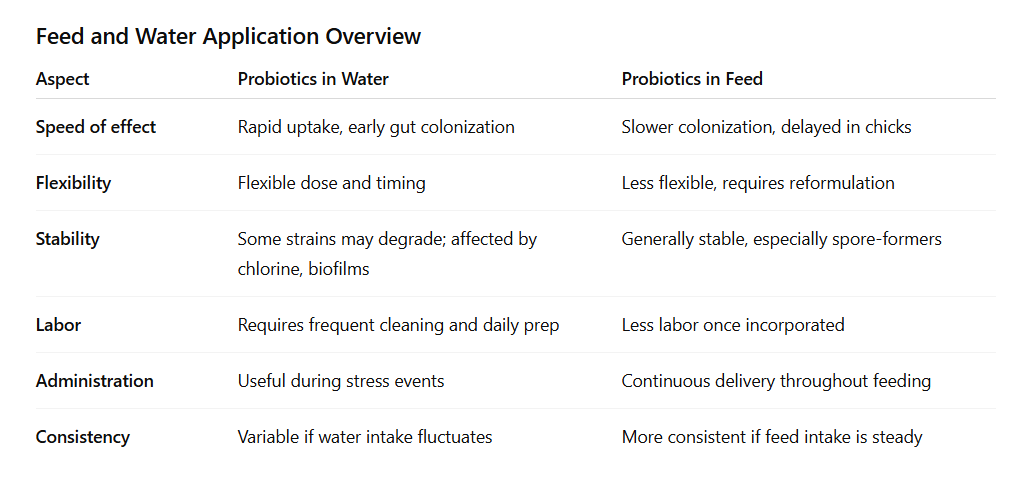
- Water application is ideal for early gut colonization, rapid intervention, and targeted use.
- Feed application provides stability, consistency, and long-term support.
- In practice, many producers combine both approaches: water-based probiotics at chick placement or during stress, and feed-based probiotics for continuous support.
What do I choose - single or multi-strain probiotics?
Some probiotics contain one species of bacteria, some contain multiple species of bacteria, and some contain multiple strains of the same species. The choice of product depends on what the goal is for using the probiotic and what the probiotic strain can do.
- If the aim is to target a specific pathogen, then a single-strain probiotic is suitable if it has activity against that pathogen.
- If the aim is to provide bacteria to seed the chick gut, then a multi-strain probiotic may be more appropriate to promote bacterial diversity.
- If the aim is to fulfill multiple actions, then a multi-strain product may be more appropriate (unless all the desired actions are fulfilled by one species).
- Ultimately, ask the probiotic manufacturer to provide what their product can do and check that it will fulfill the requirements on farm.
Competitive exclusion products
Competitive exclusion products are direct-fed microbials with an undefined mix of bacteria isolated from healthy adult chickens. These products were first used in the poultry industry to inhibit bacteria like E. coli and Salmonella spp. through the process of competitive exclusion. Competitive exclusion is the process by which beneficial bacteria compete with pathogens for attachment sites and nutrients in the gut and, thus, exclude the pathogen. Over time, these products also provide young chicks with a beneficial microbiota after hatching and help restore gut balance.
Acids in poultry production
Acids are widely used in poultry to inhibit pathogens, sanitize water, and improve gut health. They are classified as organic (carbon-based, weak acids such as acetic, lactic, propionic, and butyric) and inorganic (non-carbon, strong acids like sulphuric, phosphoric, and hydrochloric). Most gut health applications rely on organic acids, which can be delivered via water or feed.
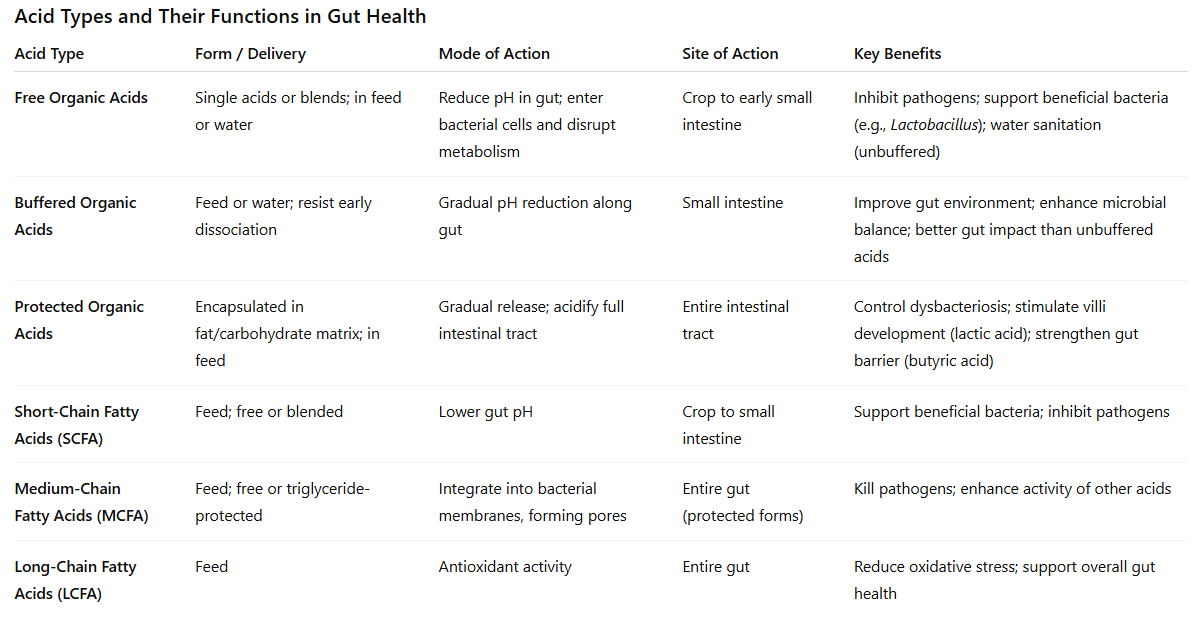
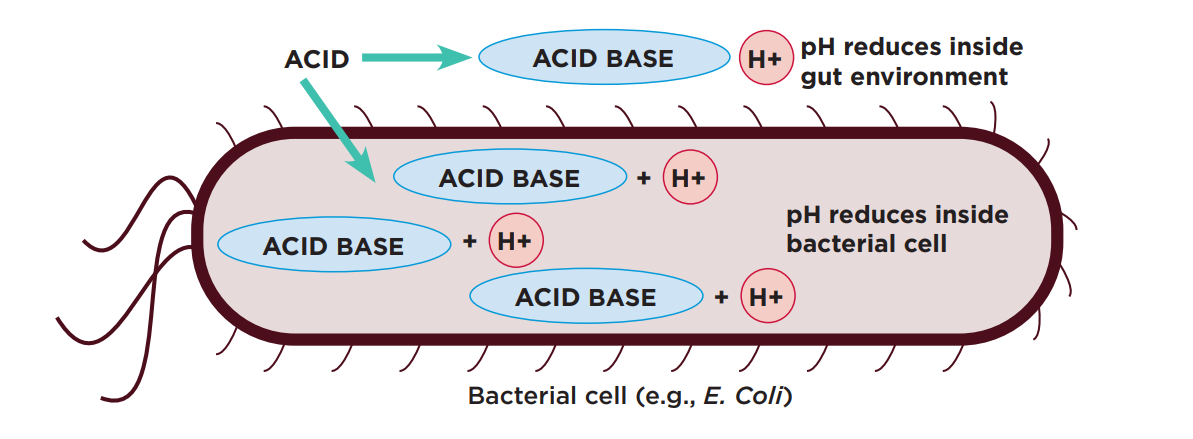
During dissociation, the hydrogen ion is released by the acid. During this process the pH will fall, resulting a more acidic environment. Different acids dissociate under different conditions, which is why acid blends can be more effective. Some acids will dissociate in the gut lumen, reducing the pH in the gut environment. Other acids will do this in the bacterial cells and inhibit growth.
Phytogenic products
Phytogenic products are plant-derived compounds that enhance gut health through multiple mechanisms, including antimicrobial and antiparasitic effects, immune stimulation, reducing inflammation, improving gut tissue development, and influencing feed intake. They can be delivered in feed or water, depending on the formulation and farm requirements.
Common Sources:
- Oregano, thyme, rosemary, cinnamon, capsicum, clove
Presentations:
- Dried plant material – cheapest form but variable active compound concentration.
- Extracted natural oils/compounds – consistent dosing and higher product reliability.
- Nature identical compounds – chemically synthesized versions of active plant compounds.
Additional Notes:
- Can be blended with other gut enhancers, such as organic acids.
- Some products are encapsulated for slow release along the intestinal tract, similar to protected organic acids.
Prebiotics
Prebiotics are non-digestible ingredients that selectively stimulate the growth or activity of beneficial gut microbiota, supporting gut health and inhibiting harmful bacteria.
Common Prebiotics:
- Fructooligosaccharides (FOS)
- Galactooligosaccharides (GOS)
- Pectin
- Mannan-oligosaccharides (MOS) – prevent attachment of pathogens like E. coli and Salmonella
Key Points:
- Not digested by the host; utilized by gut microbes
- Heat-stable and easily incorporated into feed
- Often combined with probiotics in synbiotic products to support beneficial bacterial growth
Postbiotics
Postbiotics are products derived from bacterial or yeast fermentation, where metabolites and beneficial compounds are produced and the cells are subsequently inactivated by heat.
Key Benefits:
- Inhibit pathogens
- Stimulate gut development
- Modulate and stimulate immune response
- Improve overall gut function
Administration:
- Can be added to feed or delivered via water lines
Toxin binders
Toxin binders are products that adsorb or neutralize harmful substances, preventing them from damaging the intestinal tract.
Applications:
- Used when flocks are at risk from toxins, such as mycotoxins
- Selection depends on the type of toxin present in the feed or environment
Feed enzymes
Feed enzymes support gut health indirectly by improving nutrient availability and digestion.
Functions:
- Break down anti-nutritional factors in feed such as phytate, arabinoxylans, and beta-glucans
- Reduce gut viscosity and enhance nutrient absorption
- Support overall gut function and bird performance
Administration:
- Included directly in the diet
Conclusion
Gut health products vary in mode of action and impact, with no single solution suitable for all flocks. Choosing the right product requires understanding how it supports the gut at different stages of a bird’s life. Effective gut support often involves a strategy that evolves from chick to adult. While probiotics, organic acids, or essential oils can be beneficial if they meet the bird’s needs, optimal gut health also depends on sound management practices, including litter, feed, water quality, and biosecurity. Full benefits may take several flocks to become apparent.