





Why microbial load and physical form matter in poultry
Feed quality beyond the formula
 27 January 2026
 5 minute read
 By:
By: While modern feed formulation establishes nutrient specifications, true animal performance is driven by the composition and quality of the feed matrix delivered to the animal. While poultry diets are formulated to digestible amino acids, energy density, and mineral balance, birds ultimately consume a manufactured material whose microbial profile and physical structure are shaped by ingredient sourcing, milling, and distribution. Two practical dimensions—microbial load (including pathogen risk) and physical quality (pellet durability, particle size distribution, and fines)—can materially influence intestinal function, flock uniformity, and the efficiency of converting feed inputs into meat and eggs.
Feed is not just nutrition; it is also a microbial exposure route
Feed is distributed at scale and delivered routinely across integrated production systems, making it an efficient pathway for microorganisms to move downstream. A systematic review and meta-analysis estimated that approximately 9% of finished feed samples were Salmonella-positive across published studies, with detection also reported in raw ingredients and manufacturing environments (Parker et al., 2022). Importantly, contamination is not only an incoming ingredient issue; the mill environment can contribute through persistence and spread. In Great Britain, Salmonella was isolated from 20 of 22 commercial feed mills producing broiler rations using extensive dust and swab sampling (Davies & Wray, 2021).
From an animal perspective, elevated microbial pressure drives early microbiome evolution which is foundational to intestinal development and nutrient absorption. When microbial communities are unstable, the gut may shift toward a more defensive state, often with consequences for growth consistency and feed efficiency.
What processing does (and does not) solve
Thermal processing is helpful, but it does not guarantee sterility—particularly when recontamination occurs after heat treatment (e.g., during cooling, conveying, storage, or transport). Research has shown pelleting conditions can effectively reduce Salmonella levels in the feed, but incomplete lethality and post-process recontamination mean additional control measures are still required (Jones, 2011).
Where mills apply more intensive process interventions, reductions can improve. A feed manufacturing study using Enterococcus faecium as a Salmonella surrogate, determined standard pelleting achieved roughly a 3-log reduction in cells numbers, while more thermally aggressive pelleting with a Hygieniser system achieved roughly a 4-log reduction (Boltz et al., 2019). The operational takeaway is that microbial management is best approached as a production program: upstream risk reduction, validated processing, and downstream control to limit recontamination.
Evidence that reducing feed-associated pressure can influence Salmonella outcomes in birds
Beyond the mill, the practical question is whether feed hygiene and microbial management translate into outcomes relevant to food safety and flock performance. Research has shown that that organic acids delivered in feed were associated with substantially reduced odds of Salmonella-positive crop samples in broilers relative to controls (Wang et al., 2025). Although organic acids represent only one intervention class, these findings reinforce a broader principle: what enters birds via feed can influence colonization dynamics in key gastrointestinal sites.
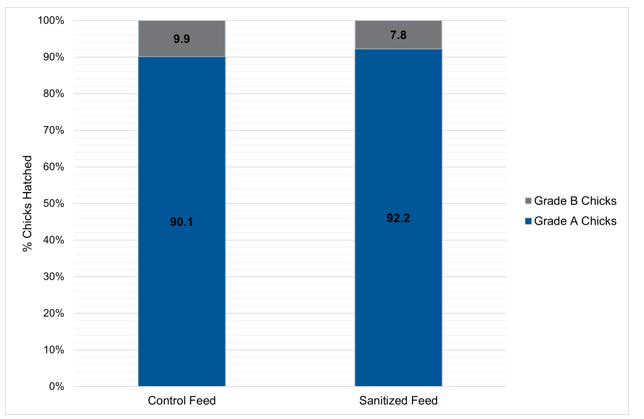
Microbial challenges that raise food safety risks can likewise contribute to increased weight variability and poorer digestibility, particularly during early life stages when the gut and immune system are still maturing. Feed sanitizers can provide an additional, scalable tool to reduce the microbial load delivered via feed. Applied to raw materials and/or finished feed, they are intended to lower overall microbial levels and help manage post-processing recontamination risk during storage, transport, and on-farm handling. In a recent broiler breeder study, reducing feed microbial load was associated with downstream hygiene benefits, including reduced eggshell surface microbial load and improved chick quality indicators, supporting the concept that feed microbial status can influence early-life exposure (Avila et al., 2023).
Figure 1. The impact of sanitization on the microbial load of mash broiler-breeder feed
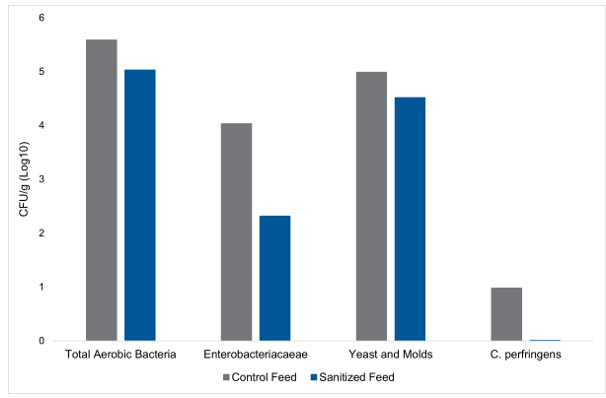
Figure 2. The impact mash feed sanitization on the microbial load of eggshell surfaces in broiler-breeder hens
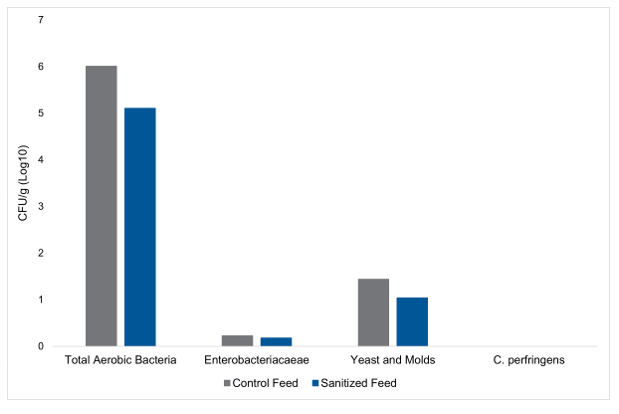
Figure 3. The impact of mash feed sanitization on chick quality of broiler breeder hens
Physical form is a performance variable, not a cosmetic preference
Feed quality also depends on physical characteristics established between formulation and consumption. Pellet durability, particle size distribution, and the proportion of fines can affect intake behavior, nutrient delivery consistency, and feed wastage. Excess fines can increase sorting, reduce uniformity of consumption, and compromise overall performance.
In a broiler study that varied pellet-to-fines proportions across a 63-day production period, higher fines inclusion was associated with poorer feed conversion and unfavorable carcass yield outcomes compared with pellet-containing treatments (McCafferty & Purswell, 2023). The economic implication is straightforward: if physical form increases intake inefficiency or non-uniform consumption, the value of an optimized formulation is diluted before it reaches the bird’s metabolism.
Enteric disease pressure amplifies the value of consistent feed quality
Enteric challenges—whether from coccidial cycling, dysbiosis, or necrotic enteritis (NE)—create periods when birds are less tolerant of additional stressors. During these times, even modest increases in microbial load or inconsistencies in intake can magnify performance penalties.
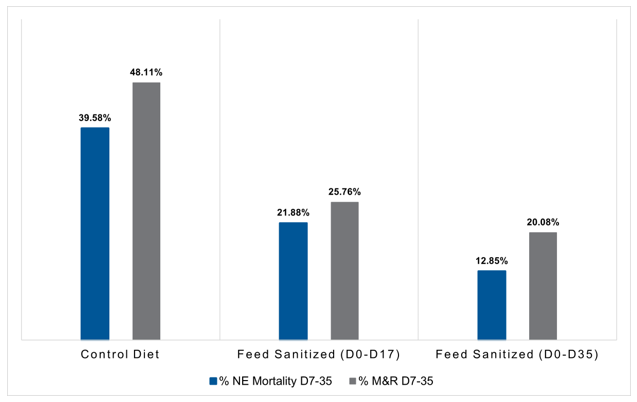
Under NE challenge conditions, blended organic acid strategies have been reported to mitigate aspects of subclinical NE impact, including improvements in feed efficiency measures relative to challenged controls (Kumar et al., 2021). Additional challenge work performed by Colorado Quality Research indicates that sanitized feed was associated with improved health-related outcomes under NE pressure, including reduced NE-related losses and improved survivability metrics versus controls (Figure 4). Practically, the value of microbial and physical consistency may be greatest during early life—when gut development is most sensitive—and during ration changes, when variability in intake and exposure can increase. These measures do not replace broader NE control programs; rather, they can reduce background feed-associated pressures that compound disease susceptibility.
Figure 4. Birds fed sanitized feed demonstrated lower NE-related mortality and mortality and removal (M&R) in a NE challenge model compared to birds fed a control diet.
Practical strategy: manage microbial load and physical form as one program
For most operations, the actionable question is where to intervene in a way that is measurable, repeatable, and cost-effective.
- Treat feed hygiene as a core control point
Because feed moves daily across production chains, it is a reliable touchpoint for consistent microbial risk reduction. - Reduce microbial load and protect against recontamination
Validate thermal processing, then implement sanitation and post-process controls to minimize reintroduction of contaminants. - Optimize pellet quality as a biological KPI
Monitor pellet durability and fines as outcomes tied to consumption efficiency, uniformity, and yield. - Prioritize high-impact windows
Early life, ration transitions, and predictable disease-pressure periods are times when microbial and physical consistency can deliver the greatest return.
Managing feed hygiene and physical form aligns food safety objectives with performance outcomes. By reducing avoidable microbial exposure and maintaining consistent intake, producers can support gut resilience and uniformity while improving the efficiency with which feed inputs are converted into meat and eggs.
To learn how managing feed microbial load and physical quality can support gut resilience, flock uniformity, and feed efficiency, Clean Feed Expert today.
| References | ||||
|---|---|---|---|---|
| Boltz, T. P., Evans, C. E., Smith, D. R., et al. (2019). The effect of standard pelleting and more thermally aggressive pelleting utilizing a hygieniser on feed manufacture and reduction of Enterococcus faecium, a Salmonella surrogate. Journal of Applied Poultry Research. | ||||
| Davies, R. H., & Wray, C. (2021). Investigations into Salmonella contamination in feed mills producing rations for the broiler industry in Great Britain. Veterinary Sciences. | ||||
| Jones, F. T. (2011). A review of practical Salmonella control measures in animal feed. Journal of Applied Poultry Research. | ||||
| Kumar, A., Toghyani, M., Kheravii, S. K., et al. (2021). Potential of blended organic acids to improve performance and health of broilers infected with necrotic enteritis. Animal Nutrition, 7, 440–449. | ||||
| McCafferty, K. W., & Purswell, J. L. (2023). Effects of feeding varying proportions of pellets and fines on growth performance and carcass yield of broilers during a 63-day production period. Journal of Applied Poultry Research, 32(2), 100332. | ||||
| Parker, E. M., Parker, A. J., Short, G., O’Connor, A. M., & Wittum, T. E. (2022). Salmonella detection in commercially prepared livestock feed and the raw ingredients and equipment used to manufacture the feed: A systematic review and meta-analysis. Preventive Veterinary Medicine, 198, 105546. | ||||
| Wang, J., et al. (2025). A systematic review and meta-analysis of the efficacy of organic acids in reducing Salmonella colonization in the crop and ceca of broilers. Poultry Science. | ||||