




Bird flu vaccination gains ground worldwide, WEO meeting hears
France's vaccinated ducks endure toughest season yet
 6 July 2026
 5 minute read
 By:
By: France’s efforts to vaccinate against highly pathogenic avian influenza (HPAI) proved successful in the toughest season on record, according to data presented at the World Egg Organisation's spring meeting in Warsaw.
According to Marie Laborde, deputy director of France's Interprofessional Committee for Foie Gras Ducks and Geese (CIFOG), the country recorded 121 outbreaks during the 2025-26 season. Some 1.7 million birds were culled as a result of outbreaks, a number that also includes deaths among vaccinated flocks. Laborde said the season brought exceptional pressure from wildlife. Analysis traced more than 40 virus introductions back to wild birds.
Despite that pressure, Laborde said the outcome validated the programme. Comparing vaccinated and unvaccinated regions across two seasons, she said the conclusion is clear.
“Vaccination is not being questioned,” she said.
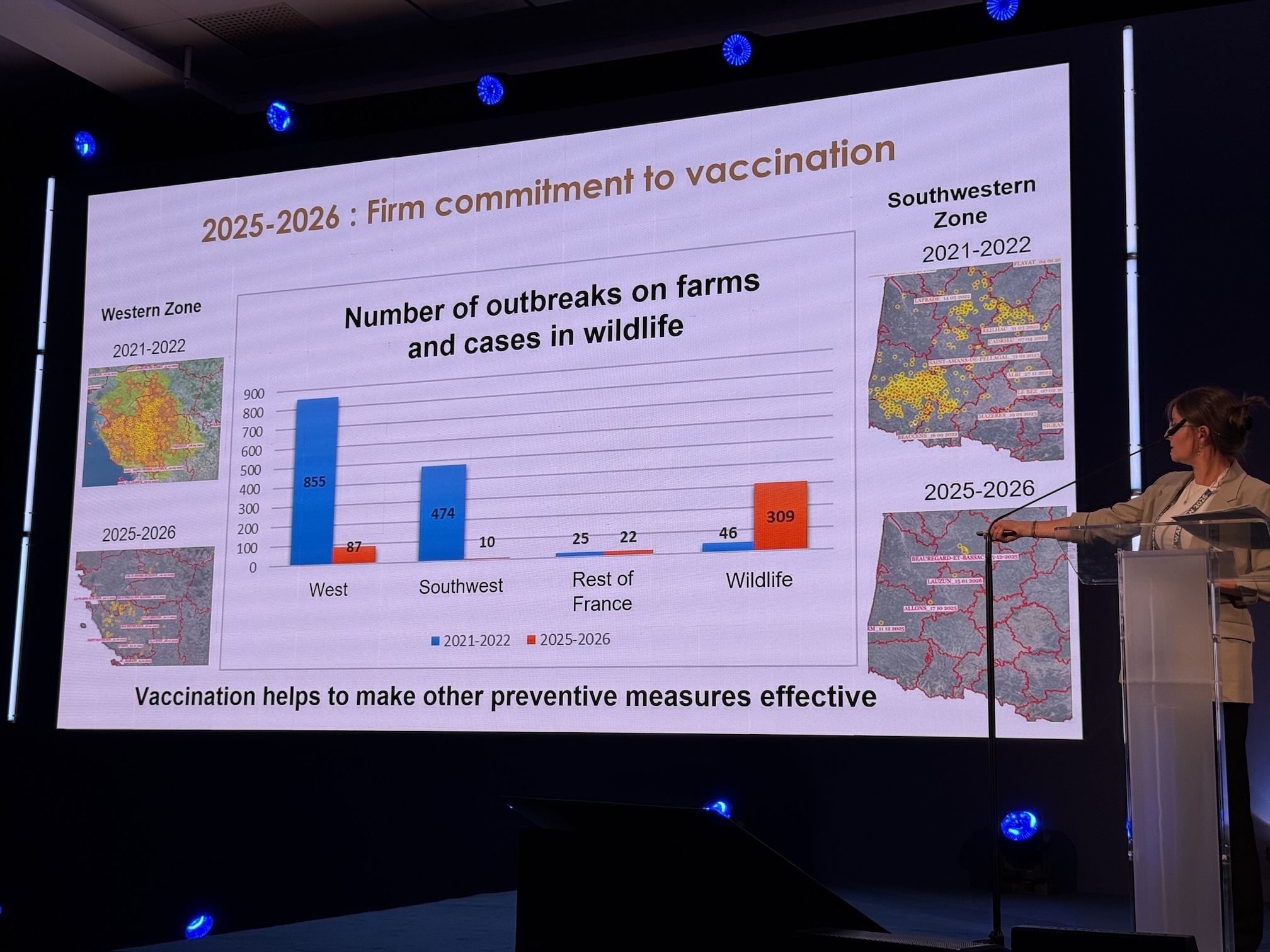
In regions where birds were not vaccinated, the outbreak numbers were similar to those of past crisis years, she said. Vaccinated regions, by contrast, saw culling limited to the infected site itself, avoiding the wider preventive culling France has traditionally relied on.
France began mandatory vaccination of ducks on farms with more than 250 birds in October 2023, using one of two authorised vaccines and a two-injection protocol. Using scientific modelling, Laborde said more than 96% of outbreaks were prevented in the 2023-24 season due to vaccination.
“We can say we have moved from a crisis management approach to a preventive approach,” she said.
The addition of a third injection likely played a role in protecting the ducks, which Laborde said are particularly difficult to immunise. The third injection, she believes, helped counter waning immunity, which begins to decline around the six-week mark.
The programme, however, has been costly. France spends about 100 million euros a year vaccinating its duck flocks. At a cost of roughly 1.56 euro per bird, the cost is split. Industry pays 60%, and 40% of the bill goes to the state. About half of that covers surveillance, which Laborde called the “cornerstone” of the system.
Trade has been less impacted than the industry feared, Laborde said. Most markets still accept cooked duck products from vaccinated birds, and the United Kingdom has reopened to raw product, with Chile “almost reopened.” Raw product remains restricted in the United States, Canada, Japan, Thailand and South Korea, though Laborde said talks were ongoing in several of those markets.
The Netherlands runs vaccine trials
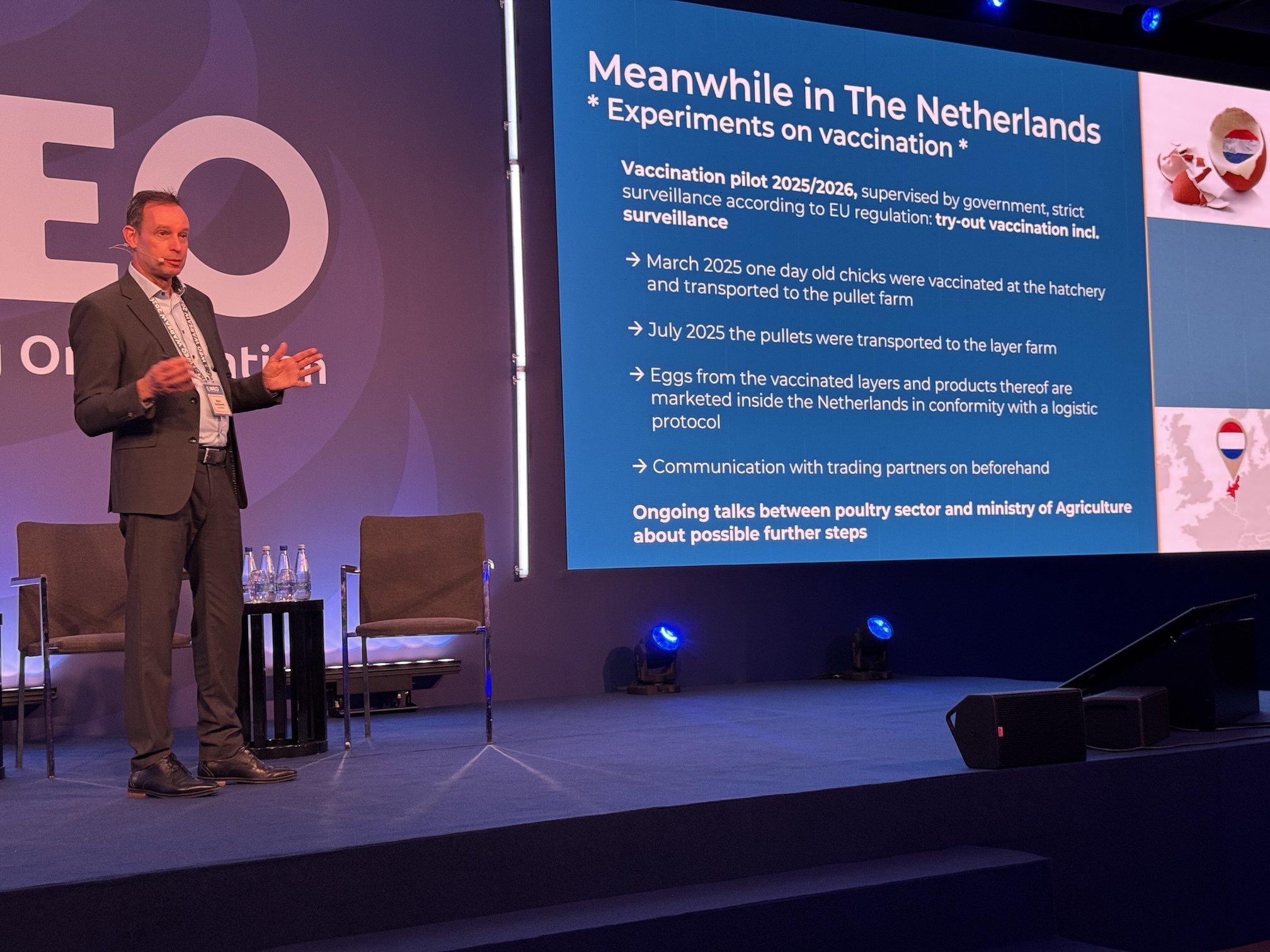
Ben Dallaert, director of the National Poultry Association in the Netherlands and chair of the WEO's Avian Influenza Global Expert Group, said the Dutch are conducting two trials, a research study and a commercial pilot programme.
The first study, which began in September 2023, monitored vaccinated hens for more than 85 weeks, evaluating two vaccines, VAXXITEK HVT+IBD+H5 and Vectormune AI, one tested with an additional booster dose. While the results had not yet been published at the time of the conference, Dallaert said preliminary results showed that the birds “were not ill” and “hardly spread the virus.” The results have since been published by Wageningen UR.
Dutch researchers have also been running a small pilot programme since March 2025, vaccinating day-old chicks at the hatchery before transferring them to a layer farm. Eggs from those birds are now being marketed inside the country under an EU-compliant surveillance protocol.
Dallaert said the ministry of agriculture and industry communicated the plan to trading partners including Germany and Japan before launch, and that the response so far had been supportive.
Italy pauses vaccination plan as Denmark, Japan move ahead
Earlier in the session, Olivier Espeisse, a veterinary and pharmaceutical advisor to the WEO, said United Nations’ Food and Agriculture Organisation data showed that Europe took the worst of it in terms of outbreaks in the past season. There was a high concentration of cases in both commercial poultry and wild birds.
Asia, including Japan, South Korea, Indonesia, Bangladesh and India, also reported outbreaks, while South America saw comparatively few until a developing situation emerged in Chile in April.
Espeisse said wild bird pressure has increased considerably. Pressure remains unpredictable from year to year. He briefly mentioned a case reported that was highlighted in the press as the first human avian influenza case in Europe, saying that framing was actually inaccurate. The patient, he said, had tuberculosis and was infected with a low pathogenic H9 strain from an undetermined source.
“The danger of contamination is always there,” Espeisse said, adding that it would take only a mutation for the virus to become transmissible between humans.

On vaccination adoption, Espeisse said Italy's plan to vaccinate turkeys and layers in three provinces has been postponed indefinitely amid concerns about managing a regional rollout when birds move between areas.
Denmark is now considering turkey vaccination starting as early as September, while Japan, historically opposed to vaccination, is drafting a plan after concluding new technology addresses its previous objections.
Canada and the United Kingdom have also started trial vaccination programmes involving turkeys and laboratory viral challenge, though neither has produced published results yet.
At the World Organisation for Animal Health, Espeisse said a working group led by scientist David Swayne is developing non-binding guidance on surveillance standards for vaccinated flocks, intended to give countries a shared reference point for trade, with a deadline of mid-2027. A parallel group is drafting guidance on compensating farmers for HPAI losses.
Dallaert said the expert group, which has been operating for more than a decade, has built a set of shared resources for countries weighing vaccination, including a crisis communications toolkit and practical guidance on surveillance for vaccinated flocks.
“We're not finished yet, but we are on our way,” he said of the group's work.
A January meeting in Guatemala, coordinated with local authorities and industry, serves as an example of that outreach in practice. Around 10 government officials and 100 industry representatives attended a briefing on surveillance, vaccination results and biosecurity, according to a video message played from Guatemala during the session.
Dallaert closed with a comment on the Dutch situation, expressing a concern that was echoed by others in the room.
“We believe in the future of vaccinated birds, but for us, it’s also important that this is accepted all over the world,” he said.

Melanie Epp
Melanie Epp is a freelance agricultural journalist from Ontario, Canada.