






Nobilis Influenza H5 Vaccine in Ducks
By Intervet - Nine three week old conventional Peking ducks were vaccinated once with one ml (double the chicken dose) of Nobilis Influenza H5 via the subcutaneous route. One duck served as control. 20 November 2006
 1 minute read

Summary of Trial and Results
-
During an observation period of five weeks blood samples were collected at three, four and five weeks post vaccination. The ducks were housed in an isolator for the duration of the trial and observed daily for clinical signs of disease or adverse reactions to the vaccine.
-
All ducks vaccinated produced detectable antibodies to avian Influenza type H5 from three weeks post vaccination. Antibodies, measured by hemagglutination inhibition assay (HI) using two different test antigens of types H5N2 and H5N6, reached a mean titer of log2 6.0 and 6.6 respectively at five weeks post vaccination (Figure 1). No antibody titers were observed in the control animal.
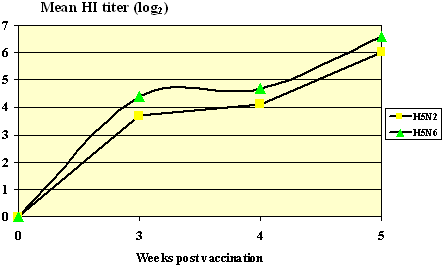 Figure 1: Antibody response in ducks to vaccination with Nobilis Influenza H5 measured at 3, 4 and 5 weeks post vaccination by hemagglutination inhibition assay (HI) using two different antigens (H5N2 and H5N6 |
Discussion and Conclusions
-
It can be concluded that Nobilis Influenza H5 has the potency to induce a significant antibody response in ducks to the H5 subtype of Avian Influenza.
-
Because ducks are more resistant to avian influenza than chickens it was anticipated that a higher vaccine dose would be required to induce antibody titres comparable to those induced in chickens. For this reason in this experiment ducks were vaccinated with 1 ml vaccine (double recommended chicken dose).
-
Nobilis Influenza H5 induces H5 specific antibodies in ducks as from 3 weeks post-vaccination. (In 2 of the ducks titers were only demonstrated 5 weeks post-vaccination.) The level of antibody titer demonstrated in ducks exceeds the antibody titer level known to be protective in chickens when challenged with highly virulent Avian Influenzavirus of H5 subtype.
-
Further challenge experiments are required to confirm the ability of the vaccine to reduce virus shedding after infection and the minimum protective antibody titer in ducks.