


Warning: session_start() [function.session-start]: open(/var/tmp//sess_b66a02c5a75ccbd419d038078a0c6064, O_RDWR) failed: No space left on device (28) in /usr/home/customers/5menterprise/www.thepoultrysite.com/includes/config.php on line 3

Warning: session_start() [function.session-start]: Cannot send session cookie - headers already sent by (output started at /usr/home/customers/5menterprise/www.thepoultrysite.com/includes/config.php:3) in /usr/home/customers/5menterprise/www.thepoultrysite.com/includes/config.php on line 3

Warning: session_start() [function.session-start]: Cannot send session cache limiter - headers already sent (output started at /usr/home/customers/5menterprise/www.thepoultrysite.com/includes/config.php:3) in /usr/home/customers/5menterprise/www.thepoultrysite.com/includes/config.php on line 3
Coccidiosis, Caecal, E tenella - Diseases of Poultry from The Poultry Site
decrease font size
increase font size
change type face
bookmark this page
email this page
print this page

ThePoultrySite Quick Disease Guide

Disease:
 

Use the above box to quickly switch to another disease
Contents of Quick Disease Guide

Coccidiosis, Caecal, E tenella

Related Products:

Extracted From:
A Pocket Guide to
Poultry Health
and
Disease
Order me a copy
By Paul McMullin
© 2004
Click Here to
Order Your Copy

Introduction

This was at one time the commonest type of coccidiosis and is certainly the most easily diagnosed. It is caused by Eimeria tenella and results in lesions in the caecum of chickens worldwide. Morbidity is 10-40% and mortality up to 50%. Transmission as for E. mitis (see above).

Signs

  • Depression.
  • Ruffled feathers.
  • Closed eyes.
  • Inappetance.
  • Diarrhoea, blood in faeces.
  • Production less affected than in some of the other forms of coccidiosis.

Post-mortem lesions

  • Petechiae.
  • Thickening, ecchymoses, of caecal mucosa.
  • Accumulation of varying quantities of blood and caseous necrotic material in the caecum.

Diagnosis

Signs, lesions, microscopic examination of scrapings. Differentiate from ulcerative enteritis, histomonosis.

Treatment

Toltrazuril, Sulphonamides, Amprolium, Vitamins A and K in feed or water.

Prevention

Coccidiostats in feed, vaccination by controlled exposure, hygiene. E. tenella is more common when 'straight' ionophore programmes are used. Shuttle programmes with chemicals in the starter diet usually improve control. In some markets the organic arsenical compound 3-Nitro is used as an aid in the control of caecal coccidiosis. Vaccines are used mainly in breeders but increasingly in broilers. Recovered birds have good immunity to the same parasite.
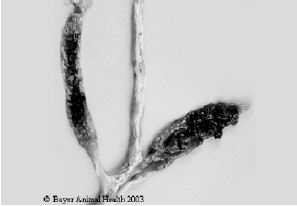
Figure 15. Moderate Eimeria tenella infection in the caecae of a chicken (Score 3). The caecal walls are thickened and haemorrhagic and there is a mass of blood in the caecal lumen.


Our Web Sites
ThePigSite
ThePoultrySite
TheCattleSite
TheFishSite
TheBioenergySite
Chinese Web Sites
ThePigSite China
ThePoultrySite China

Monday 12th May

Search Site


Warning: Unknown: open(/var/tmp//sess_b66a02c5a75ccbd419d038078a0c6064, O_RDWR) failed: No space left on device (28) in Unknown on line 0

Warning: Unknown: Failed to write session data (files). Please verify that the current setting of session.save_path is correct () in Unknown on line 0