





Without U.S. Rules, Biotech Food Lacks Investors
US - This little piggy’s manure causes less pollution. This little piggy produces extra milk for her babies. And this little piggy makes fatty acids normally found in fish, so that eating its bacon might actually be good for you. 31 July 2007
 1 minute read
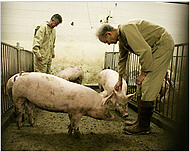 |
| Meet the Enviropigs. They have cleaner manure and healthier meat. |
The three pigs, all now living in experimental farmyards, are among the genetically engineered animals whose meat might one day turn up on American dinner plates. Bioengineers have also developed salmon that grow to market weight in about half the typical time, disease-resistant cows and catfish needing fewer antibiotics, and goats whose milk might help ward off infections in children who drink it.
Only now, though, do federal officials seem to be getting serious about drafting rules that would determine whether and how such meat, milk and filets can safely enter the nation’s food supply.
Some scientists and biotechnology executives say that by having the Food and Drug Administration spell out the rules of the game, big investors would finally be willing to put up money to create a market in so-called transgenic livestock.
“Right now, it’s very hard to get any corporate investment,” said James D. Murray, a professor at the University of California, Davis, who developed the goats with the infection-fighting milk. “What studies do you need to do? What are they looking for?” he said, referring to government regulators. “That stuff’s not there.”
But some experts caution that even if the F.D.A. clears the regulatory path in coming months, investors and agribusiness companies might still shy away. Many fear that consumers would shun foods from transgenic animals, sometimes referred to as genetically modified organisms, or G.M.O.’s.
“The companies we have spoken to have gone organic, and they are very concerned, at least up to the present time, of having G.M.O. associated with their name,” said Cecil W. Forsberg, a professor at the University of Guelph in Ontario, Canada, who helped developed the “Enviropig” with the cleaner manure. Smithfield Foods, for one, the world’s largest hog producer and pork processor, says it is doing no research on genetically engineered animals.