




Extending laying cycles without compromise with BACTOCELL
A reliable gut-driven probiotic solution
 23 October 2025
 2 minute read
 By:
By: As the poultry industry aims to extend laying cycles to meet rising global egg demand and evolving welfare standards, maintaining eggshell quality and hen health has become a critical challenge. Longer cycles often result in larger eggs and reduced calcium metabolism efficiency, leading to thinner eggshells and more downgraded eggs—directly impacting profitability.
Backed by science and trusted in the field, BACTOCELL has a proven track record of over 25 years of success in poultry, especially in laying hens. This probiotic is a lactic acid bacteria (Pediococcus acidilactici CNCM I-4622) validated and registered in the EU as a zootechnical additive for all avian species. BACTOCELL was specifically selected for its ability to produce high levels of L+ lactic acid, which serves as a direct energy source for birds through epithelial absorption and indirectly via cross-feeding, acting as a substrate for short-chain fatty acid–producing bacteria, such as butyrate producers. This unique metabolic trait supports intestinal health, feed efficiency, and a balanced gut microbiota—key factors in sustaining egg production and eggshell quality throughout the laying cycle while preserving hen physiology and welfare.
A multi-trial study involving 990 eggs across early (≤26 weeks of age), mid (26–47 weeks of age), and late (≥47 weeks of age) laying phases demonstrated the efficacy of feeding diets supplemented with BACTOCELL at the recommended dose of 100 g/ton of feed (1x10⁶ CFU/g). Results showed:
- a significant increase in egg weight: +2.5% (p<0.05)
- markedly thicker eggshells: +13.8% (p<0.05)
a significant reduction in downgraded eggs: 3.5% for control eggs vs 0.0% for BACTOCELL eggs (p<0.05).
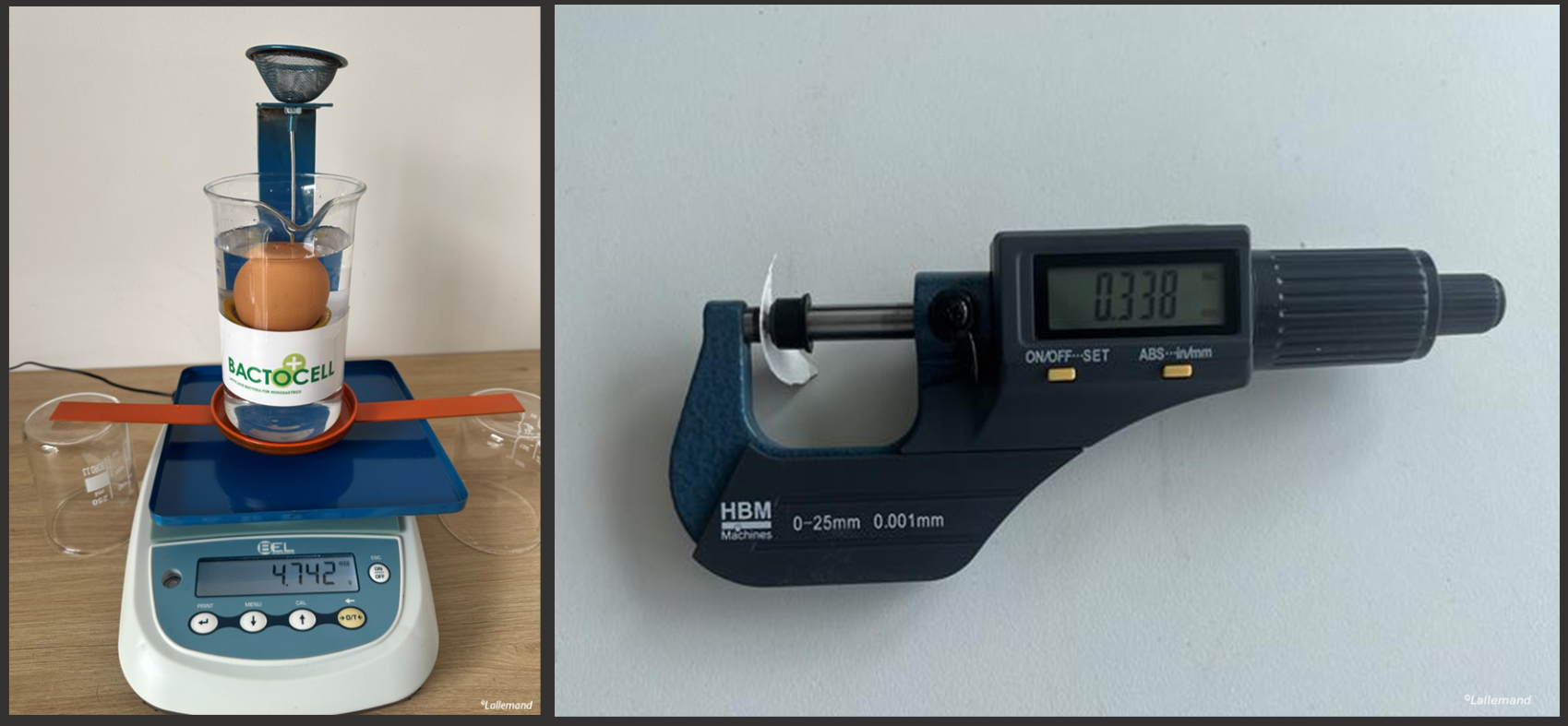
Illustration of eggshell quality evaluation techniques: non-invasive egg specific gravity assessment using a dedicated device developed by Lallemand (left), and invasive eggshell thickness measurement using a micrometric screw (right)
Hens fed with the probiotic Pediococcus acidilactici CNCM I-4622 performed better throughout their laying cycle. They laid eggs of higher overall quality with stronger shells. When looking at eggshell strength, using a measure called "specific gravity" (SG), 90.1% of the eggs from BACTOCELL-fed hens had strong shells (SG > 1.080). In comparison, only 69.8% of the eggs from hens without BACTOCELL reached this level, representing a 29% improvement. The biggest benefits were seen in mid-laying cycle, where eggshell strength increased by nearly 64%. Late-lay hens also gained thicker eggshells (+6.2%), helping maintain egg quality even as the hens aged.
Shanmugam et al. (2024) investigated the effects of BACTOCELL on calcium metabolism and showed that both blood and bone concentrations of calcium and phosphorus increased following BACTOCELL supplementation, improving the mineral supply for eggshell formation while maintaining bone integrity.
Notably, supplementing hens with Pediococcus acidilactici CNCM I-4622 led to a 4-percentage-point improvement in both calcium and phosphorus mineral retention (p<0.05), resulting in increased:
- bone hardness (+19%, p<0.1),
- bone cohesiveness (+43%, p<0.05)
bone calcium and phosphorus concentration (+1-percentage-point, p<0.05).
Additionally, BACTOCELL promoted a substantial increase in two key hormones involved in calcium metabolism - calcitriol (+83%, p<0.05) and osteocalcin (+3%, p<0.01)-, resulting in higher circulating calcium and phosphorus levels.
Therefore, BACTOCELL enhances calcium assimilation and mineralization, supporting laying hens throughout their production cycle and improving eggshell quality.
These findings confirm that BACTOCELL supplementation is a proven, science-backed nutritional solution to enhance egg and eggshell quality across all stages of the laying cycle—supporting both productivity and hen welfare. More than a probiotic, BACTOCELL is a reliable partner to help improve the sustainability of egg production: extending the laying cycle, ensuring lasting performance with top-grade eggs and resilient hens.