







IPPE: Wireless Egg Node technology reveals hidden losses in poultry supply chains
ORKA’s sensor-based monitoring system reveals where shocks and handling issues occur, helping reduce losses across the egg supply chain
 By:
By: Josh Yoshida, vice president, sales and marketing at ORKA Food Technology, spoke to The Poultry Site’s Sarah Mikesell at IPPE 2026 in Atlanta, Georgia, USA, about it’s Wireless Egg Node, known as the gold standard in egg monitoring technology. It is trusted and used by leading egg producers, graders and equipment manufacturers all over the world.
Josh, tell us about ORKA’s Wireless Egg Node.
The Wireless Egg Node provides real-time monitoring of shocks, vibrations, rotation, tilting and temperature affecting eggs. It is designed to track eggs from the laying location all the way to the point of sale.
By pinpointing the exact locations where eggs are damaged, the Wireless Egg Node allows operators to take targeted corrective actions, reducing breakage and losses, improving operational efficiency, and increasing profitability for egg production farms and hatching companies.
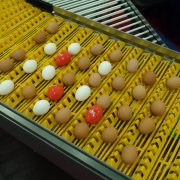
This year at IPPE, we are focusing on our Wireless Egg Node. In 2025, a significant number of Latin American companies ordered this machine. In some countries, about 12% or 13% of eggs are broken on the way to consumers. If you can save even 1% or 1.5% of those eggs, it's going to be a huge profit which is a tangible benefit for stakeholders.
This is the reason Latin American companies ordered our Wireless Egg Node because it can definitely help to reduce breaking of eggs. You can put our “eggs” on the conveyor system, grading area, packing machines and on the truck during transportation, and it can identify the place where eggs are being broken by offering an indicator at the location. By using this device, you can reduce and locate the issue so that you can take care of that location immediately, reducing egg damage.
How Wireless Egg Node works
We are showing two eggs, but it can run theoretically up to 100 eggs. And four eggs can be seen on the same monitor window. Then you can see immediately whenever it gets hit, in real time. That place is a problematic place, and you can take care of that specific location and reduce the breaking of eggs.
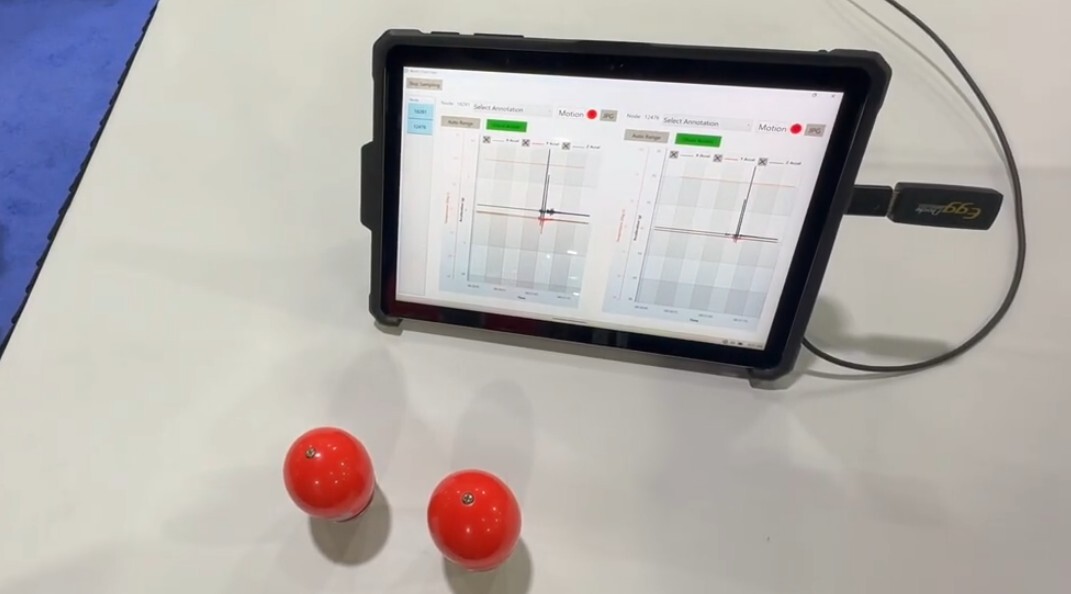
The big advantage of our Wireless Egg Node is that we have both data logging mode and real-time mode. Data logging mode means that the device itself records all the data inside, then later you connect with your computer and download all the data to analyze it. Our Wireless Egg Node has this function as well, but the problem is that after, let's say, 12.5 minutes from the beginning, you don't know where it happened, right? So, you have to create a mapping. Otherwise, the data is not helpful.
We also offer real-time mode, which of course means you can see what's happening in real-time as it’s happening. You can run the egg, and you can even walk by the conveyor system with the tablet and can see immediately what's going on inside your equipment.
When you see the peak, you can find the location and take corrective actions at the site of the issue. About 95% of our customers like using the real-time mode with this technology, and that's incredibly significant on our side.
Josh, this is all about economics, right? It's about helping people identify inefficiencies in their system, right?
Yes, exactly and it's very tangible. When you have it and you use it, you can immediately make changes and see the profit opportunities. I think some of our new customers hear from other customers – really word of mouth about the value the Wireless Egg Node offers.
You've had a burst of activity in Latin America, but this is a globally available product, correct?
Yes, certainly. We are in North America, and we are strong in Latin America, Asia and Europe. We have an agent in western Europe that sells to eastern Europe. But, we sell the Wireless Egg Node and our full product line, like our egg tester equipment, all over the world, but as I said, we saw strong interest from Latin America in 2025.

Sarah Mikesell
Sarah Mikesell grew up on a five-generation family farming operation in Ohio, USA, where her family still farms. She feels extraordinarily lucky to get to do what she loves - write about livestock and crop agriculture. You can find her on LinkedIn.

 1 July 2026
 2
minute read
2
minute read