






The fastest stop against early Gumboro strains
To stop the Gumboro cycle and prevent considerable losses, early protection of the birds is strongly recommended. By:
By: Infectious bursal disease (IBD) is an immunosuppressive poultry disease. Reported globally, it can infect young broilers from 2 to 5 weeks of age. Clinical signs include very virulent or subclinical manifestations. Therefore, vaccination in the hatchery is recommended to avoid clinical disease.
Through innovation with a novel frozen IBD immune complex, stopping the Gumboro cycle can be achieved much earlier than before. Nonetheless, vaccinating by subcutaneous or in-ovo routes remains a challenge in many hatcheries all over the world.
A highly contagious immunosuppressive disease
Avibirnaviruses affect the lymphoid tissues in general, and the bursa of Fabricius (BF) in particular. The BF is located dorsally to the birds’ cloaca, and it is key for the maturation of the immune system cells, which occurs during the embryonic period and the first two weeks of life after hatch. The B lymphocytes, which play a key role against pathogens, mature in the BF. They are responsible for the humoral immune response, producing antibodies which recognize and help in the clearance of pathogens.
Difficult to identify with the naked eye clinically due to its various clinical forms (from virulent to subclinical), IBD can have a detrimental impact on viability, feed conversion rate, general growth and uniformity. In addition, a general immunodepression opens the gates to other secondary infections. Thus, the susceptibility of birds to other viruses and co-infections increases.
New strains, new challenges
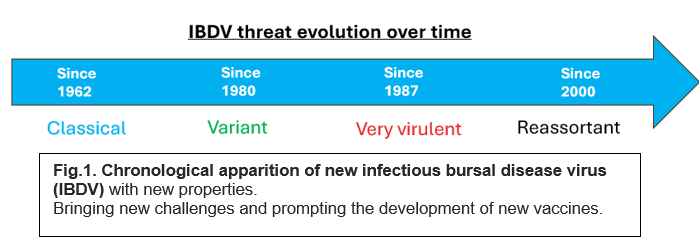
For many traditional intermediate vaccines, it is very difficult to overcome maternally derived immunity and arrive in the BF before the wild virus. Moreover, variant and very virulent strains represent nowadays 60 to 76% of the detected viruses worldwide, and this whithout considering reassortant strains, which have been reported since at least the early 2000s (Fig.1). Since IBD presents a bi-segmented RNA genome (segment A & B), when two strains co-infect a bird, they can exchange the whole segments and create a new reassortant virus. An example of that is the combination of a classical and a very virulent strain (E.g. A3B1 reassortant genotype detected in Europe). On top of this, the virus is very resistant to many disinfectants, with a high persistence in the environment, cycle after cycle.
Gumboro hatchery vaccination
To stop the Gumboro cycle and prevent considerable losses, early protection of the birds is strongly recommended. Hence the recommendation to do it at the hatchery. In the hatchery, two methods are used to administer IBD vaccines: subcutaneous injection at day-old or in-ovo vaccination at embryonic ages. The objective is to accomplish 100% well-vaccinated chicks developing an appropriate immune response and blocking the bursa from hatch to the end of their life (Fig.2).
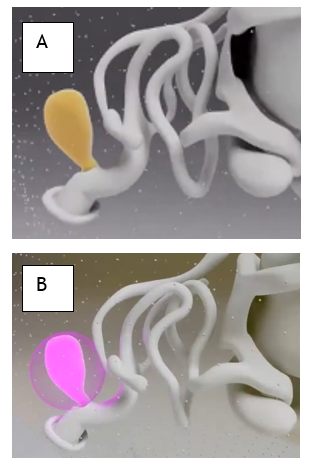
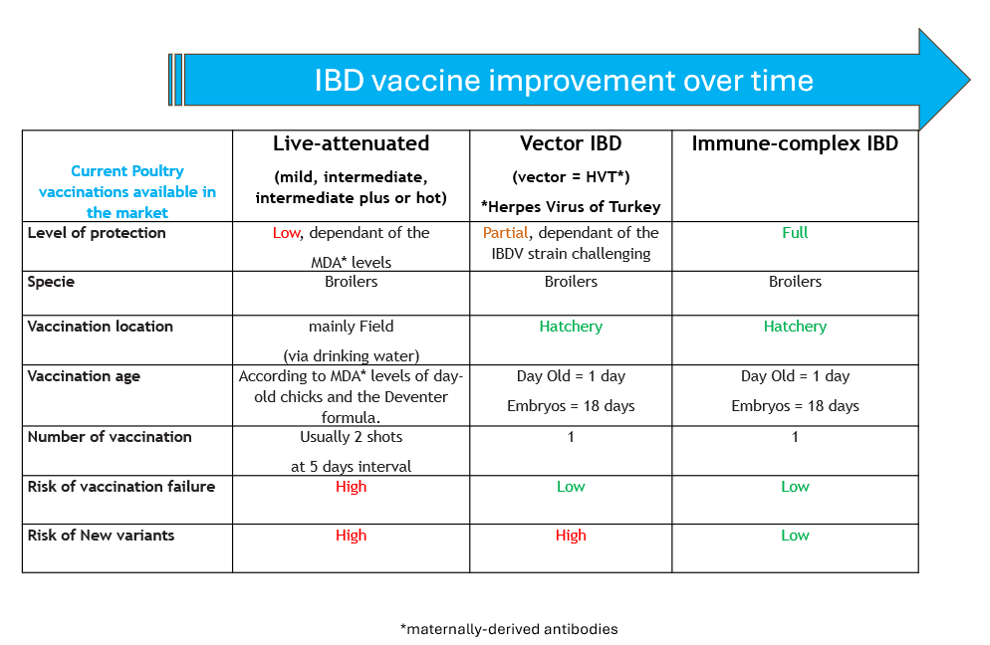
When immune complex technology is used, protection happens regardless the maternal antibody level of each individual chick. On the contrary, when other commercial vaccines are used, maternally derived antibodies might affect and neutralize them (E.g. drinking water vaccines, naked viruses applied in the hatchery). These alternative technologies are inefficient regarding 100% correct vaccination and might impact the immune system of the chicks if colonizing the BF at an early age.
A new frozen solution
To protect chicks successfully against novel and all other IBD strains, Ceva launches Nextmune®, a vaccine delivered frozen in liquid nitrogen (Fig.3) and produced using a brand-new technology and formulation.
To bring greater quality and efficiency through vaccine integrity preservation. This new cold chain management process requires expertise and training offered through the Ceva Linilog service.
1 broiler out of 3 is vaccinated against Gumboro by Ceva
Since IBD is mutating and evolving since 1962, Poultry vaccine manufacturers must continuously adapt vaccines and solutions against the new threats.
The mission of Nextmune® goes beyond chick’s protection; it blocks the shedding of the field virus and limits the selection of new strains. Over time, the field virus is finally controlled and rarely detected in the vaccinated flocks. Nonetheless, due to its natural resistance, the virus remains in the environment.
Regular monitoring and laboratory PCR results can be useful to demonstrate wild virus displacement, Gumboro cycle stop and transmission reduction.
Dovac High Speed Line, part of IBD solution control
IBD control does not only come from innovation, but also from an integrated solution. Composed of immune-complex technology, state-of-the-art machines and close-to-customer services.
Because even the best vaccines will not protect the birds if they are not applied at the right place and dose. One missed bird might compromise the success of a whole vaccination program, generally composed of several vaccinations directed to protect against different poultry diseases.
Hence optimizing the hatchery day-old chicks’ vaccination plays a key role in the IBD disease control. And that’s why the Dovac High Speed Line recently came into the market. Replacing the table-like systems (Fig.4).

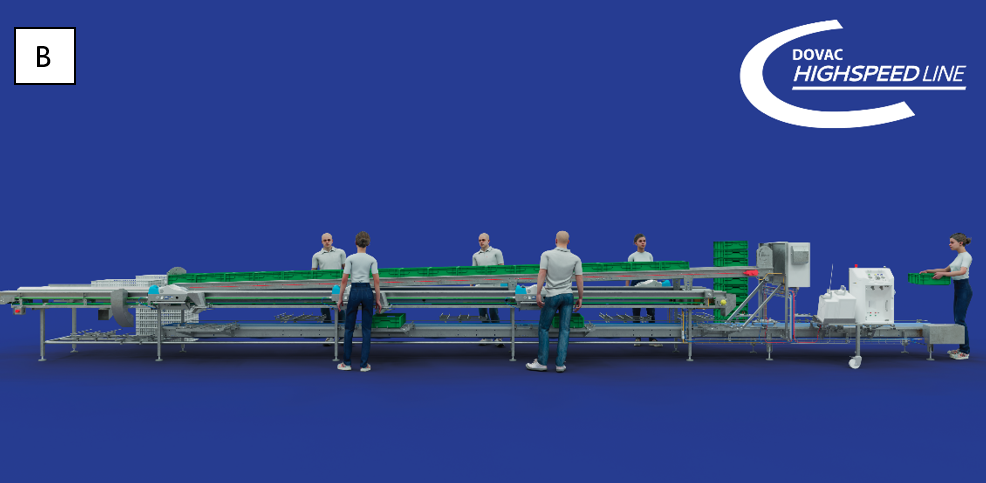
Improving efficiency - fewer errors at higher speed - of non-automated hatcheries vaccinating against IBD through subcutaneous injection route. While reducing up to 20% of human resources, the Dovac High Speed Line workflow optimization allows to increase the vaccination process speed by 25%.
Conclusion: IBD stop from start for sustainability
IBD ranks among the top five most costly poultry diseases.
This disease compromises the performance of poultry flocks, leading to carcass heterogeneity and decreasing the economic turnover of the producers.
Since threats are continuously emerging, it is of utmost importance to continue evolving and adapting to the field situation by using the proper preventative solutions ensuring protection right from the hatchery. To secure production sustainability.


Mathilde Lecoupeur
 3 July 2026
 3
minute read
3
minute read