





USSEC CrushCon 2025: What are the global themes to watch in 2026 in poultry production
Energy, geopolitics and heat stress are the new pressures on poultry feed
 By:
By:
The global soybean market is entering a period of structural change driven by urbanization, energy constraints, geopolitical realignment and rising expectations around feed quality.
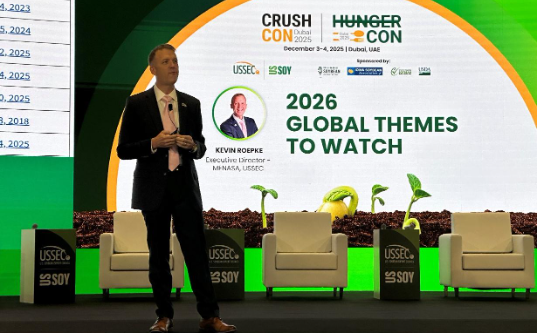
According to Kevin Roepke, Executive Director of U.S. Soybean Export Council for the Middle East, North Africa and South Asia (MENASA), these forces are not isolated trends but interconnected pressures reshaping how soybeans are produced, traded and utilized across animal agriculture.
Speaking to an international audience, Roepke framed his outlook with a cultural reference that underscored the scale of transformation underway.
“I’ve summarized the following presentation by this fantastic Bob Dylan song… ‘the times, they are a-changin’,” he said. “I think it summarizes a lot of the things that are happening in the world today.”
Urbanization and protein demand
Roepke began by pointing to demographic shifts that are redefining consumption patterns. For the first time in decades, Tokyo is no longer the world’s largest city, with South and Southeast Asian megacities now dominating global rankings.
“According to the United Nations, Tokyo is now the third largest city in the world, with Jakarta taking the first position,” Roepke said. “And interestingly enough, a city that doesn’t get a lot of recognition, Dhaka from Bangladesh, is now the second largest city in the world.”
Looking ahead, he noted that Dhaka is projected to become the world’s largest megacity by 2050, followed by Jakarta, Shanghai and New Delhi, regions that already play a critical role in global soybean demand.
As cities urbanize, Roepke emphasized, diets change in predictable ways.
“As cities are urbanized, there are a couple of interesting things that happen with respect to their consumption habits, specifically with animal proteins,” he said. “This is obviously a major driver for soy and our growth trajectory.”
Analyzing consumption against purchasing power parity, Roepke explained that animal protein intake rises rapidly as incomes increase up to roughly $20,000 per capita, then begins to plateau. Vegetable oil consumption, however, follows a different pattern.
“The vegetable oil component looks quite different than the animal protein component does,” he said. “We see a very consistent channel in purchasing power parity versus consumption from basically zero all the way up to $20,000.”
Beyond that threshold, consumption trends diverge by region, with many Asian and Middle Eastern countries showing flattening or declining per-capita vegetable oil use. For soybeans, this underscores the importance of both protein and oil demand dynamics when evaluating future growth.
Strategic security reshapes production
One of the dominant themes Roepke highlighted was the emergence of what he called “a new era of strategic security.” Countries are increasingly prioritizing control over critical resources, from minerals to food.
“I think in the United States what you’re seeing is a heavy emphasis on rare earth minerals, or critical minerals,” he said. “But this is variable from country to country.”
In the Middle East, food security has become a strategic priority, particularly in poultry production. Roepke cited Saudi Arabia as a key example, referencing data showing the country is driving much of the region’s projected poultry sector growth.
“This is driven by a vision 2030 to increase its domestic poultry sector and try and replace imports,” he said. “This is very much a strategic security of food sovereignty.”
The implications for soybeans are significant. As countries expand domestic animal protein production, demand for reliable, high-quality feed ingredients intensifies and often in regions with limited natural resources and challenging climates.
Energy costs and heat stress converge
Rising energy costs are another force reshaping the soybean and feed landscape. Roepke pointed to the rapid expansion of artificial intelligence and data centers as an unexpected driver of global energy demand.
“Given this incredible thirst for artificial intelligence and this incredible hunger for data centers… you’re seeing an escalation in energy prices around the world, especially in Europe,” he said.
Higher energy prices affect both oilseed crushing and animal production.
“This is having a tremendous impact on two factors,” Roepke explained. “One is the crush sector, but the second is the cost of energy to produce birds.”
As poultry production concentrates in warmer regions such as the Middle East, South Asia and North Africa, energy-intensive cooling becomes increasingly critical.
“What is it going to cost to keep a bird cool? I think it’s going to change in the near future,” he said, adding that heat stress will become “more and more of a relevant topic.”
Practical AI moves from hype to application
While artificial intelligence contributes to energy demand, Roepke also emphasized its growing role in improving efficiency across agriculture and processing.
“The market right now is looking for actual applicability, practical applications that they can use to increase their productivity,” he said.
One example is thermal anomaly detection, which can identify subtle changes in bird temperature associated with heat stress. Importantly, Roepke stressed that these technologies are no longer theoretical.
“This isn’t just theoretical,” he said. “This is actually being put in place in the Cargill’s multi-seed crush plant in Rotterdam.”
AI systems are already being used to monitor sensors, detect anomalies and predict operational challenges. These tools can improve efficiency and reduce risk across the oilseed and feed value chain.
Geopolitical re-clustering and trade uncertainty
Roepke described a world undergoing “geopolitical re-clustering,” with shifting alliances and trade relationships altering how commodities move.
“I think the world is changing,” he said. “As Bob Dylan said, the times, they are changing.”
Rather than offering predictions, Roepke said he uses prediction markets as a way to gauge expectations around trade policy.
“I have no idea,” he said. “I’ve stopped predicting.”
He also urged greater awareness of sanctions and compliance risks.
“I’ve personally looked at the OFAC website probably more in the last 30 days than I have in my entire career,” Roepke said.
While some argue that sanctions could lead to de-dollarization, Roepke pushed back on that narrative.
“The world continues to see more dollarized denominated trades… not fewer,” he said, adding that the U.S. dollar is increasing its relevance over time.
Economic slowdown and risk management
Turning to global economic risks, Roepke noted that while trade volumes grew by 2.4% in 2025, growth is expected to slow to just 0.5%.
“When the tide goes out, do you actually realize who’s swimming naked,” he said, quoting Warren Buffett. “Is the tide going out? I think for some industries it is.”
He reinforced the importance of proactive risk management. “It is important not to ignore risks, no matter who you are,” Roepke said.
Among the risks he identified were workforce disruption from AI, cybersecurity vulnerabilities and quality challenges as production expands faster than export infrastructure.
Rethinking quality in soybeans
Quality, Roepke argued, is one of the most underappreciated risks and opportunities in the soybean market. He challenged the industry’s reliance on crude protein as a primary metric, noting that the industry is losing sight of what’s really important – amino acids.
Moreover, differences in production, storage, transportation, and drying between the U.S. and South American origins translate into significant differences in quality between the two origins. “Slow, solar drying contributes to higher digestibility, more sugar content, and better solubility when compared to artificial, or wood-fired drying - commonly used in South America,” added Roepke.
This, he claims, gives U.S. soybeans the advantage of the 4Ds of solar-dried soy:
- Dried Naturally
- Very Low Damage
- Not Deforested
- Super Digestibility
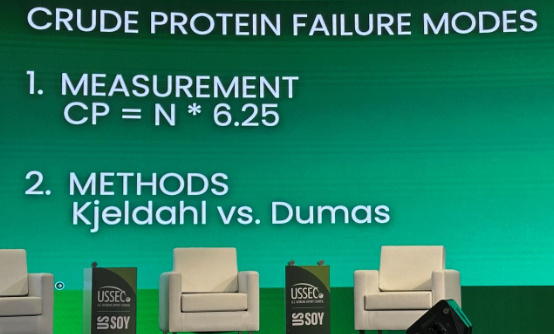
Methodological differences can further complicate interpretation.
“There are basically two different methodologies… the Kjeldahl method and the Dumas method,” he said. “Which method are you using? Do you even know?”
Damage content, digestibility and mycotoxin levels, he argued, are far more relevant, especially under heat stress conditions.
“U.S. Soy has 5x less damage content than soy from Brazil,” he said. “Plus, Brazilian damage is actually trending higher over time, and I think it’s again a function of its productive capacity, kind of outstripping its ability to evacuate the soybeans.”
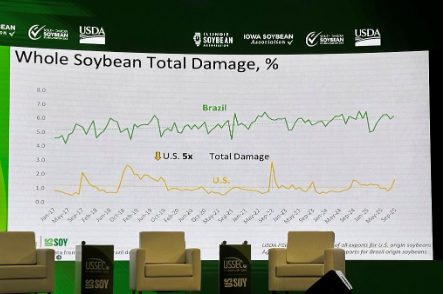
“Heat-stressed birds need even more digestible proteins,” Roepke said. “Undigestible feed exacerbates heat stress on birds, creating more challenges.”
Breaking the cycle
Roepke concluded by connecting the dots between energy costs, strategic sovereignty, localized poultry production and rising heat stress. These forces, he said, create a reinforcing cycle that threatens efficiency and sustainability.
But there is a path forward.
“By using more digestible proteins and more digestible soybean meal with higher energy content, we can actually increase the performance of the birds,” he said.
He emphasized that modern poultry genetics are designed to utilize high-quality feed efficiently without increasing metabolic heat.
“They need highly digestible proteins,” Roepke said. “They need highly digestible, metabolizable energy.”
Ultimately, Roepke positioned soybean quality – not just volume – as central to future competitiveness.
“All this, I think, is something that the U.S. Soy advantage brings to the table,” he said.
As global markets navigate demographic change, geopolitical uncertainty and rising energy costs, the soybean sector faces both risk and opportunity. The challenge, Roepke concluded, is recognizing that the times are changing and learning how to adapt to those changes.

Sarah Mikesell
Sarah Mikesell grew up on a five-generation family farming operation in Ohio, USA, where her family still farms. She feels extraordinarily lucky to get to do what she loves - write about livestock and crop agriculture. You can find her on LinkedIn.
 3 July 2026
 3
minute read
3
minute read