





US egg industry puts forward HPAI vaccination plan for laying hens
Industry working group submits detailed HPAI vaccination proposal to the USDA
 4 May 2026
 3 minute read
 By:
By: In January 2025, a group of American egg producers gathered at the International Production & Processing Expo (IPPE) in Atlanta, Georgia to talk strategy. Since 2022, more than 160 million egg-laying hens had been lost to highly pathogenic avian influenza (HPAI), with the US government paying out approximately $1.5 billion in indemnity costs across the poultry and egg sector. The payments, while substantial, didn’t come close to covering the damage on individual farms. The prevailing view at the time was that vaccination was too complicated, too politically sensitive and posed too great a risk to export markets. Frustrated, the producers convened a working group to design a vaccination plan for the US layer flock. That way, if a vaccine were to be approved, they would be ready to use it.
Speaking at the WEO Business Conference in Warsaw, Poland this month, Dr Mickey Rubin, Vice President of Research at the American Egg Board and Executive Director of the Egg Nutrition Center, outlined the proposal that followed.
“Instead of just the status quo of, ‘oh, vaccination will never happen, there's too many difficulties, too many trade barriers’,” Rubin said, “this group of producers really showed leadership by saying, ‘we have to at least start the conversation.’”
In April 2025, the working group put the finishing touches on a fully detailed vaccination proposal. The group comprised Dr John Clifford of the US Poultry and Egg Export Council, Dr Craig Rowles of Versova, Dr Travis Schaal of Forsman Farms, and Dr David Swayne, former director of the USDA-ARS Southeast Poultry Research Laboratory. Clifford's inclusion, said Rubin, was deliberate. His presence ensured the broiler sector, which had been historically cautious about vaccination and its potential impact on exports, had a voice from the outset.
The proposal centres on a vaccination zone approach that includes a targeted rollout in defined high-risk states, covering laying hens and potentially turkeys, with broilers explicitly excluded.
The proposal calls for a two-shot protocol using existing licensed vaccines, a prime dose at the hatchery, followed by a booster at seven to 15 weeks. All products from vaccinated birds would remain in the US domestic market unless individually negotiated with trading partners.
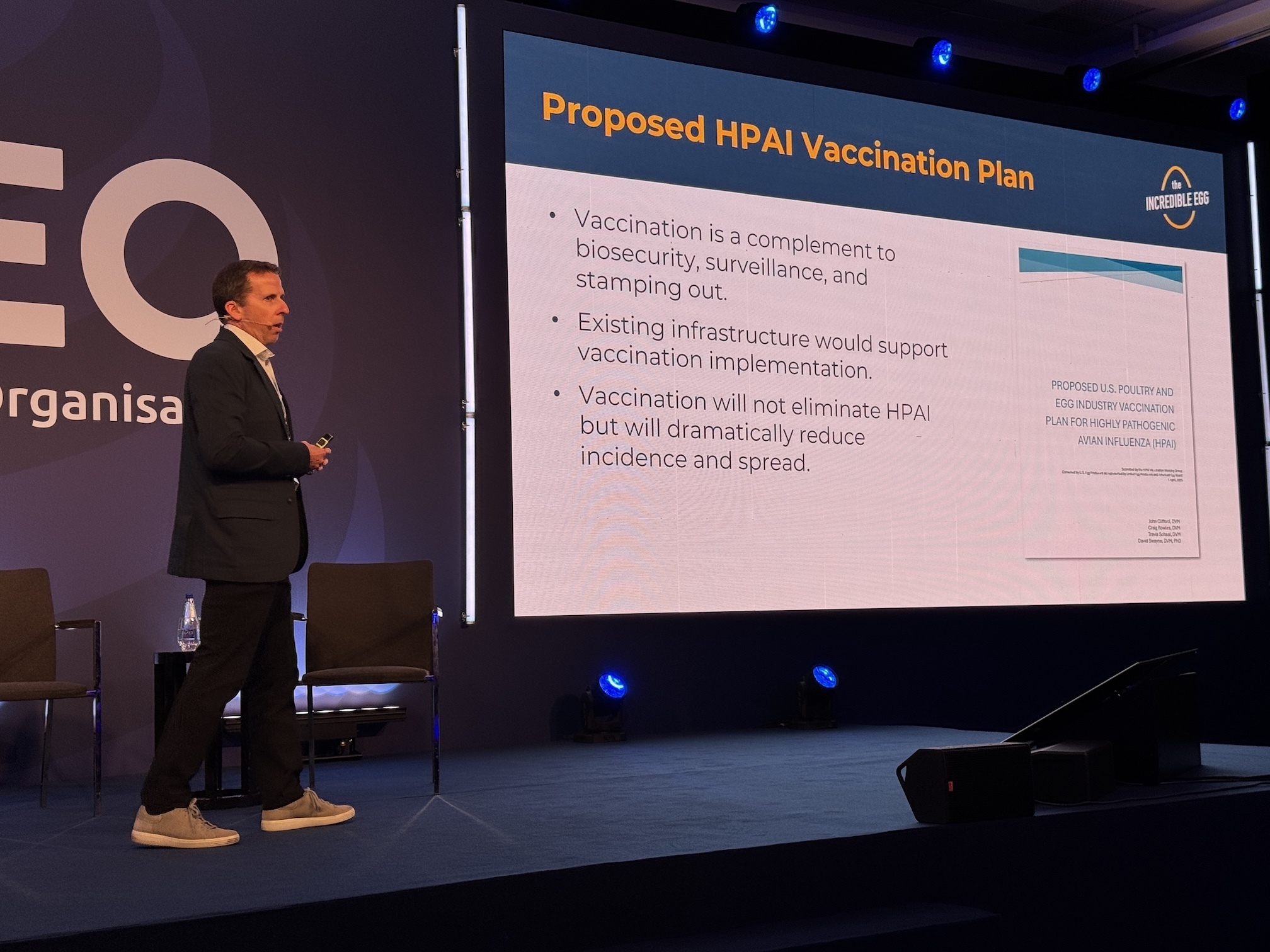
Surveillance, the proposal suggested, should draw on the existing National Poultry Improvement Plan infrastructure, with pooled samples tested every 14 days – or one full avian influenza incubation period. Depopulation of positive flocks would continue regardless of vaccination status. Rubin estimated the surveillance cost at under one dollar per hen.
At the request of the US Department of Agriculture (USDA), the group developed a separate, more detailed pilot proposal, designed for implementation in a single state or localised area. Its main purpose was to demonstrate that a targeted HPAI vaccination programme, including tracking, monitoring and surveillance, could be delivered using existing infrastructure. The secondary aim was to assess vaccine effectiveness against H5N1 2.3.4.4b in pullets and laying hens.
Rubin said the USDA developed its own parallel plan and sought the working group's feedback.
“The USDA version of the plan and the plan that our working group has proposed are highly compatible,” Rubin said.
The pilot proposal has been submitted, but approval to proceed has not yet been granted.
“We are currently at a standstill,” Rubin told the WEO delegates.
When asked whether USDA staffing and budget reductions posed a risk to the surveillance capacity the programme would require, Rubin said: “I’m not going to lie. That's probably going to be a challenge.”
Asked whether opposition from the broiler sector remained a factor in the delay, he said: “I would be lying if I said that wasn't still an issue.”
Regardless, egg producers continue to push for approval, he said, adding that progress in other countries could drive decision-making.
“If the international community continues to advance, hopefully that will force the United States to continue to advance,” he said.
The UK and Canada are both currently developing vaccination pilots of their own.

Melanie Epp
Melanie Epp is a freelance agricultural journalist from Ontario, Canada.