




From Scotland to America, egg farmers call for bird flu vaccination
Repeated HPAI outbreaks leave producers questioning biosecurity’s limits
 3 June 2026
 4 minute read
 By:
By: Karen Campbell was in the middle of a busy week when the call came. It was December 2025, and the co-owner of Glenrath Farms, one of Scotland’s largest egg producers, was hosting a student from Canada, managing the aftermath of her mother’s death and navigating family affairs when one of the farm’s managers reported higher-than-usual mortality in a shed. A second call followed shortly after: ministry vets were on site taking samples.
“That sinking feeling…” she said. “You just feel that something was very badly wrong, but you didn’t know how bad it was going to be yet.”
Hoping for the best, but preparing for the worst, Campbell braced herself for further news. It came later that day. An outbreak of highly pathogenic avian influenza was confirmed. What followed over the next several weeks — culls, empty sheds, mountains of paperwork, and daily government meetings, including on Christmas Day — reshaped how Campbell thinks about the disease and what the industry must do about it.
“We had tears, we had frustrations, we had anger, and all the different feelings that people have when they haven’t got control of the situation,” she said.
For Campbell, one of the most troubling aspects was where the virus appeared. It wasn’t found at shed entrances where biosecurity measures were concentrated, but deep inside the barn near ventilation shafts, in locations that could not be explained by contaminated footwear or vehicle movement.
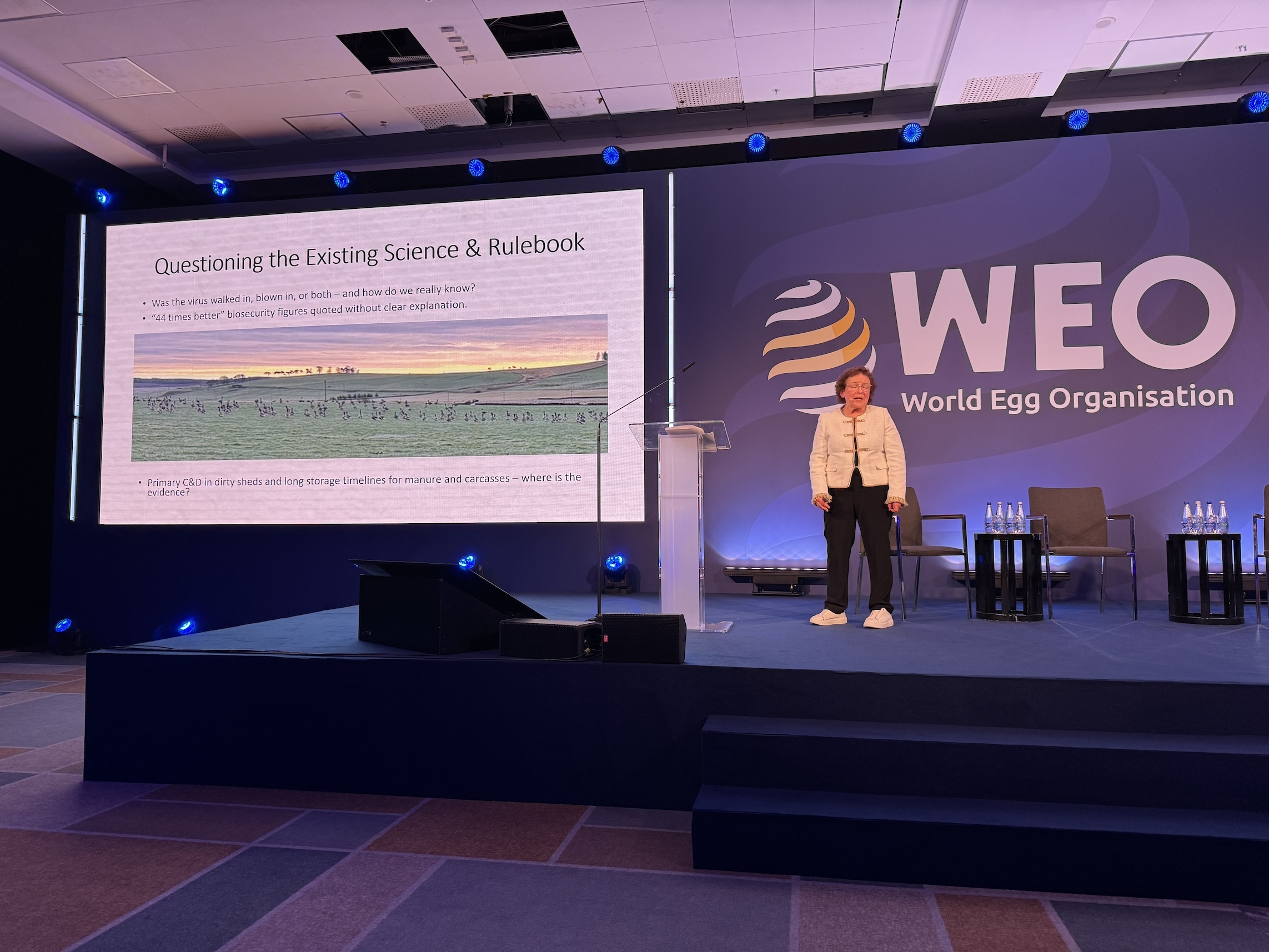
At the World Egg Organisation’s annual business conference, held this year in Warsaw, Campbell shared what she learned from the outbreak. Speaking to delegates, she stressed that biosecurity must be a constant mindset, not just a set of physical measures.
“If you don’t have it 24/7 in the mindset of the people, it’s not going to work,” she said.
While vigilance is key to keeping the virus out of the barn, biosecurity was no match for the reality on Glenrath’s range, which is home to thousands of pink-footed geese that visit daily. “How can we protect ourselves against that?” Campbell asked, pointing to a projected image of the geese.
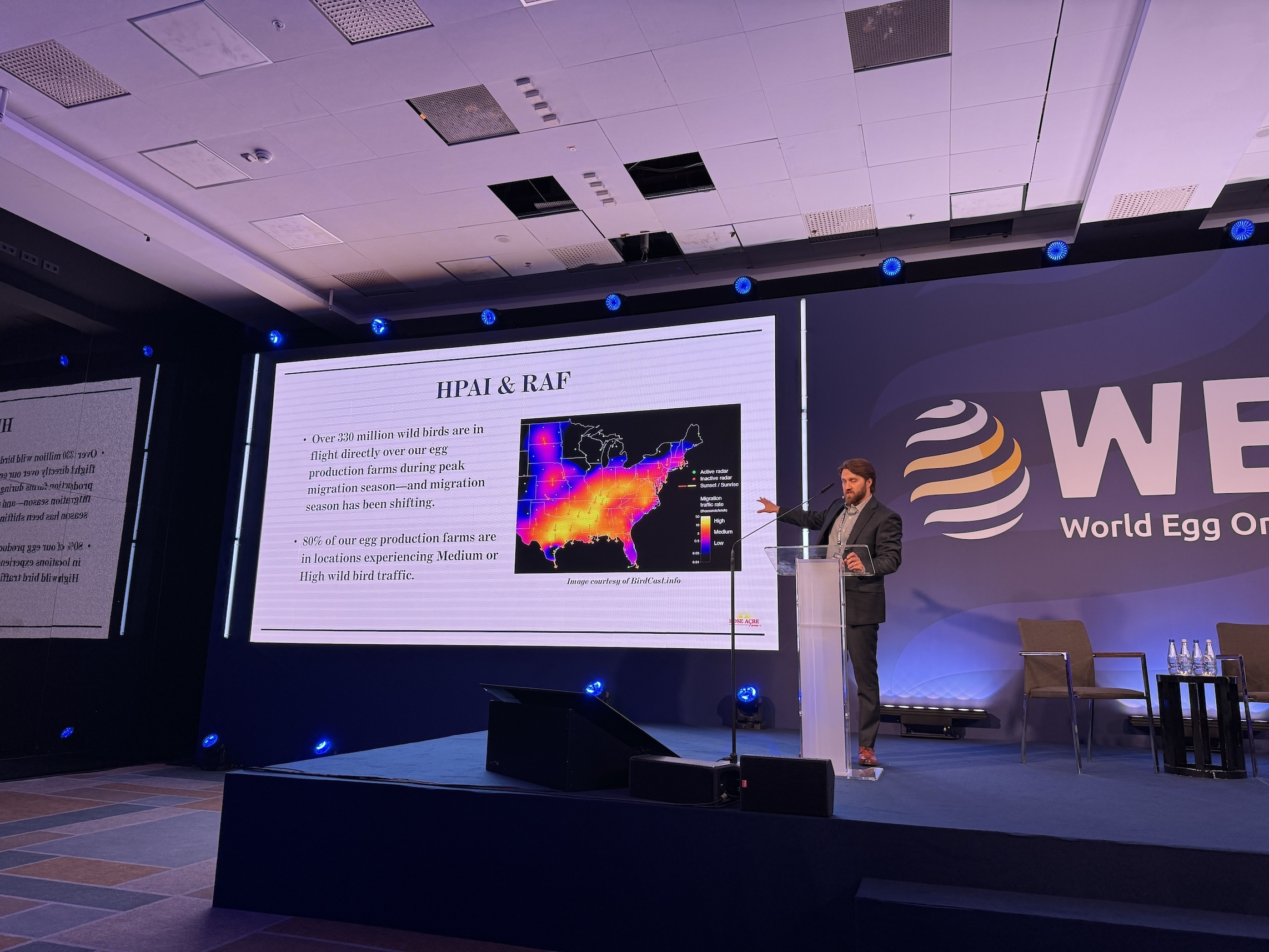
Bryce McCory has been asking similar questions for over a decade. As a third-generation owner at Rose Acre Farms, one of the largest egg producers in the United States, McCory has lived through six HPAI infections across multiple states. Two farms in Iowa were hit in 2015, followed by another in Iowa in 2022. In early 2025, farms in North Carolina and Indiana — each housing around three million birds — were infected within weeks of each other. North Carolina was hit again in February 2026.
After 2015, Rose Acre invested heavily in biosecurity: shower-in facilities, Danish entry systems, disinfectant foot pans, spray bars for incoming vehicles and laser systems to deter wild birds. The company also pre-positioned cleaning and disinfection supplies in warehouses, ready to be delivered to any farm within hours of a confirmed infection.
When thin plastic boot covers proved inadequate, thicker rubber alternatives were sourced. More recently, inflatable tube figures – the kind typically seen at used car lots in the US – were stationed around farm perimeters to deter wild birds.
And still, the virus returned.
“Good biosecurity is not a destination,” McCory told the WEO conference. “It’s a journey. It’s an ever-evolving journey.”
McCory presented data showing more than 330 million wild birds pass directly over US egg production farms during peak migration season, with 80% of Rose Acre’s farms situated in areas of medium or high wild bird traffic.
“We have invested millions of dollars into our biosecurity programme,” he said. “And yet we still see the virus impacting us.”
The call for vaccination
Both Campbell and McCory left Warsaw with the same message: biosecurity alone is not enough, and the industry must push harder for vaccination.
Campbell drew on her own family history to make the case.
“I keep going back to remembering having my father vaccinate the birds for Newcastle disease when I was very young in the middle of the night. And it was revolutionary at that time. Then we’ve had salmonella vaccine, and it’s also very, very good as well. So why can’t we get this one over the line?”
Their calls are finding some support at the international level, though with significant caveats.
In its inaugural State of the World’s Animal Health report, published in 2025, the World Organisation for Animal Health (WOAH) acknowledged that traditional control measures, including biosecurity, surveillance and movement controls, remain essential. However, the organisation also said vaccination is a potential tool that could be used to complement existing measures while reducing the spread and severity of infections.
However, WOAH’s report stopped short of recommending vaccination as a universal solution. Instead, it stressed it must be accompanied by robust surveillance, adding that biosecurity must remain central to any response.
But for those producers who have done everything possible to boost biosecurity, the answer is more straightforward.
“Biosecurity alone isn’t the answer,” McCory said. “We continue to advocate for vaccination as well as other preventative and defensive measures.”
Melanie Epp
Melanie Epp is a freelance agricultural journalist from Ontario, Canada.